Celebrating in 2026: the 105th anniversary of the lost film Il Mostro di Frankenstein (1921); the 95th anniversary of Universal Studios’ Frankenstein (1931); the 60th anniversary of Dell Comics’ superhero version of Frankenstein (1966), Hanna Barbera’s television hero Frankenstein Jr, co-star of the series Frankenstein Jr. and The Impossibles (1966), and the films Jesse James Meets Frankenstein's Daughter (1966) and The War of the Gargantuas (1966); the 55th anniversary of General Mills’ cereal mascot Franken Berry (1971); the 50th anniversary of the Saturday-morning television series Monster Squad (1976); the 45th anniversary of the anime film Kyofu Densetsu: Kaiki! Furankenshutain (1981); the 40th anniversary of Ken Russell’s film Gothic (1986) and Fred Saberhagen’s novel The Frankenstein Papers (1986); the 25th anniversary of Curtis Jobling’s picture book Frankenstein's Cat (2001); the 20th anniversary of Grant Morrision’s comic book series Seven Soldiers: Frankenstein (2006); the 15th anniversary of Nick Dear’s play Frankenstein (2011); the 10th anniversary of the Royal Ballet's production of Frankenstein (2016); and the release of Maggie Gyllenhaal’s film Bride! (2026).
Showing posts with label Frankenstein (novel). Show all posts

Saturday, August 30, 2025

Creatures of Fancy – Mary Shelley in Dundee (2019)

I recently came across this interesting collection from the Abertay Historical Society of Dundee, Scotland.

Creatures of Fancy – Mary Shelley in Dundee (2019)

£7.50; ISBN 978-0-900019-61-6

A book of essays exploring Mary Shelley’s time in Dundee, the influence it would have on her life and work, and the rapidly growing scientific and cultural life of the town in the early 19th century.

The book can be ordered directly from the Abertay Historical Society at https://abertay.org.uk/product/creatures-of-fancy-mary-shelley-in-dundee-2019/. There is also an associated presentation available on YouTube at https://www.youtube.com/watch?v=JCOfld9m8j8&t=4s&ab_channel=AbertayHistoricalSociety


Description

CREATURES OF FANCY – MARY SHELLEY IN DUNDEE

Gordon Bannerman, Kenneth Baxter, Daniel Cook, Matthew Jarron


In June 1812 the future author of Frankenstein, Mary Godwin (later Mrs Percy Shelley), arrived in Dundee as a guest of the Baxter family. Her time in the rapidly developing town would have a significant influence on her – here for the first time she was inspired to become a writer.


This publication looks at Mary’s connections to Dundee through three separate essays, with a foreword by Billy Kay. In the first chapter, Gordon Bannerman describes the background to her visit, the connections between her family and that of textile merchant William Thomas Baxter, the friendship she developed with Baxter’s daughter Isabella and the subsequent influence of Isabella’s husband David Booth. All of this is considered in the context of the unique religious and political life of Dundee.


Mary’s visit coincided with notable developments in medicine and an increasing interest in studying nature and science, as well as a growth of popular literature and a new theatre for the town. In the second chapter, Matthew Jarron and Kenneth Baxter explore both the cultural and scientific life of Dundee at this time.


In the final chapter, Daniel Cook examines the depiction of Scotland in both Frankenstein and a later novel, The Last Man, showing that Mary’s experiences during her time here continued to have an impact on her work.


Sunday, August 27, 2023

Out Now - New Edition of The Frankenstein Legend


First published in 1973, The Frankenstein Legend: A Tribute to Mary Shelley and Boris Karloff, written by Donald F. Glut, has recently been re-issued in a second edition (published by Strange Particle Press in 2022). The work covers Shelley's novel and its adaptation on stage and screen (both film and television), for radio, in fiction, and as comics. 

Comprising over 400 pages, much of the content is repeated from the original edition, but Glur has included new and/or updated images to accompany the text. In addition, Glut adds a new illustrated afterword that provides updates to various sections of the text. 


I couldn't find a direct link for Strange Particle Press, but the book can be purchased from various online booksellers as print-on-demand and electronic versions. 


Friday, August 18, 2023

CFP Critical Insights on Mary Shelley's Frankenstein: Or, The Modern Prometheus (8/9/2023)

Sorry to have missed this earlier. It should serve as a great companion to the publisher's volumes on Mary Shelley and Stoker's Dracula.


Mary Shelley's Frankenstein: Or, The Modern Prometheus UNDER CONTRACT


deadline for submissions:
August 9, 2023

full name / name of organization:
Critical Insights Series: Salem Press

contact email:
lauranicosia@gmail.com


DEADLINE FOR PROPOSALS: Monday, August 7, 2023


We seek submissions for a Critical Insights volume, under contract with Salem Press, on Mary (Wollenstonecraft) Shelley’s, Frankenstein: Or, The Modern Prometheus. Amidst rapid technological advancements, moral dilemmas, and ethical questions surrounding scientific progress, Shelley’s iconic 1818 novel, Frankenstein, still resonates in contemporary society. The novel continues to captivate readers with its timeless themes and cautionary lessons about scientific ambition and the consequences of playing God. The frame-tale novel, often overshadowed by subsequent film versions, is groundbreaking by giving a voice to the monster via its epistolary embedded-narrative form.


In today's world, where advancements like gene editing and human augmentation are becoming a reality, Shelley's novel urges us to reflect on the ethical boundaries humanity should set for itself and the potential consequences of crossing them. The novel also has compelled readers for over two centuries for its insight into the consideration of alienation and Otherness. Victor’s monster, as an outsider, brings to light the question of what is a human as he grapples with his own isolation, a concept humans increasingly identify with in the twenty-first century. The novel also remains pertinent for its environmental concerns, as ecological critics remind readers of the responsibility humans have toward the environment.


Submissions should be representative of current critical discourse about the novel and conceptually within reach of current students at the secondary and undergraduate levels. Essays that attempt to articulate the novel’s major themes and successes especially will be appreciated, as well as those that compare her work to other compelling writers.


Submissions should be tailored to one of the following categories:
  • A COMPREHENSIVE BIOGRAPHICAL essay (this essay is limited to 2500 words);
  • A CRITICAL RECEPTION essay that traces the reception of Shelley’s novel from publication to today (~5000 words);
  • CRITICAL LENS essays that offer a close reading of the novel from a particular critical standpoint (~5000 words);
  • COMPARATIVE ANALYSIS essays that analyze the work or author in the light of another work or author(~5000 words);
  • CRITICAL READING essays that focus on contemporary readings of a Shelley’s novel, with emphasis on ways readers (i.e. students in secondary and university settings) might be able to appreciate or problematize the text(s) with new eyes and current literary theories (~5000 words).


By August 7, please submit a 250-350-word abstract, a 75-word biographical statement (including your affiliation), and contact information to the acquiring editor, Dr. Laura Nicosia: lauranicosia@gmail.com.


Submissions of approximately 5000 words (inclusive of Works Cited) will need to be completed by November 13, 2023.


Honoraria will be awarded by the publisher to contributors after publication.


Last updated June 27, 2023
This CFP has been viewed 1,333 times.

Sunday, June 19, 2022

Frankenstein in Comics New Scholarship

Apologies for tooting my own horn, but I recently had three items published based on my ongoing work on adaptations of Frankenstein the comics.

The citations are as follows:


Torregrossa, Michael A. “Building a Better Bride: Female Frankenstein Monsters in the Comics.” Proceedings of the 2020 Science Fictions Popular Cultures Academic Conference, edited by Timothy F. Slater, Carrie J. Cole, and Greg Littman, Pono Publishing, 2020, pp. 165-73. ISBN 979-8689344874 (paperback); eBook ASIN B08NT97MFD. 

Torregrossa, Michael A. “Frankenstein and Its Legacy in the Comics.” International Journal of Comic Art, vol. 23, no. 2, Fall/Winter 2021, pp. 432-40.

Torregrossa, Michael. “She Lives: Bringing the Bride of Frankenstein to Life in the Comics.” Proceedings of the 33rd Annual Far West Popular Culture Association Conference, edited by David G. Schwartz, Digital Scholarship@UNLV, 2021, digitalscholarship.unlv.edu/fwpca/33rdannual/fourtwo/3/.


Monday, November 29, 2021

Out Now: Frankenstein and Its Environments, Then and Now edited by Jerrold E. Hogle

Another new collection of essays on Frankenstein. Details copied from H-Albion at https://networks.h-net.org/node/16749/discussions/7631521/toc-huntington-library-quarterly
 
The issue can be accessed from Project MUSE at https://muse.jhu.edu/issue/44365 and/or via the links provided (if you have institutional access) or purchased direct from the publisher, University of Pennsylvania Press, for $20 at https://hlq.pennpress.org/home/.


Huntington Library Quarterly Volume 83.4  Winter 2020

Special Issue: Frankenstein and Its Environments, Then and Now 

Edited by Jerrold E. Hogle


ARTICLES
 
 
This prolegomenon to a collection of eleven essays provides a setting for them all by explaining the ongoing significance of Mary Shelley’s original Frankenstein two hundred years after it was first published; the theme of multiple “environments” that imbues Frankenstein and its offshoots and that is common to all these essays; the novel’s emergence from a generic environment of fiction (the Gothic) that established itself in the 1760s and continues to this day; the history of interpretations of Frankenstein generated by the various theoretical environments in which it has been analyzed; and how all of the following essays, including the particular environments of Frankenstein they treat, both advance that history and fit into the overall scheme of this special issue.
 
 
Of Frankenstein; or, The Modern Prometheus—as the or (appositive or alternative?) may suggest—origins are in such oversupply, such over-determination, as to make a question of origin itself. Its complex multiples extend to a report from the decade in which Frankenstein is cast, the 1790s: J. M. Itard’s De l’éducation d’un homme sauvage (1801), about a feral boy of mysterious origin. Susan Wolfson investigates the several origin-stories for, in, from, and around Mary Shelley’s durably dynamic novel, including the question of “monstrous” assignments and the riddle for Enlightenment thought about whether primitive existence is ideal innocence, or savagery.

 
The volcanic period of 1816–18 is the most recent and vivid case study we have for worldwide climate catastrophe, evident from archival and geological records of sustained extreme weather, including drought, floods, storms, and crop-killing temperature decline. The signature literary expression of this historic climate crisis occurred in Switzerland, where teenage Mary Shelley wrote Frankenstein in the midst of the disastrous “Year without a Summer,” 1816, a season of floods and food riots caused by the eruption of Mount Tambora thousands of miles away. This essay, combining climate science with historical and literary sources, reexamines the literary legend of that direful, stormy summer, which Mary Shelley spent on the shores of Lake Geneva with the poets Percy Shelley and Lord Byron, with a new and original emphasis on its climatic context. The writers huddled indoors and wrote ghost stories, while the cataclysmic weather and humanitarian emergency unfolding around them weaved its way into Mary Shelley’s imagining of a tragic monster brought to life.

 
The goal of this essay is to read Mary Shelley’s Frankenstein as a “bioethical” novel that draws upon several Romantic-era discourses that powerfully combined medical environmentalism, ecology, and political reform to criticize the “biotechnology” of her era. In her novel, Mary Shelley engages in a critique of the selective breeding that farmers of her era used to create new biological beings, as Victor Frankenstein does, by building on the role that new breeds of livestock played in the industrialization of late eighteenth-century British agriculture and the greater consumption of animal food in England. At the same time, Frankenstein also points up the problematic links between such breeding schemes and two other factors of the same period: the greater mobility of peoples and animals made viable by wide-ranging, seagoing trade, and the multiplicity of different-colored races made more apparent by how this mobility enabled the possibility of more human, as well as animal, crossbreeding.
 
 
A white, wealthy, educated male, Victor Frankenstein spends a good portion of Mary Shelley’s novel complaining about being a slave to his Creature. Victor’s laments draw attention to Frankenstein’s engagement with debates about race, slavery, and abolition. The novel seems to ask what a slave is and thereby challenges notions about racial difference and the ideals of cultural/intellectual superiority that support enslaving populations. Foundational studies by H. L. Malchow and others on race in Frankenstein have defined the views of Shelley’s father, William Godwin, as well as the pervasive ideas of the era, to clarify the ways in which the Creature is racially coded to align with stereotypes about Blacks in particular. Using these studies as a starting point, Maisha Wester specifically examines the ways in which Shelley’s text engages the anxieties born out of slave insurrections and Britain’s abolition of the slave trade. To this end, she explores Shelley’s depiction of the turbulence in British society arising from these issues, showing how the Creature’s attacks metaphorize the insurrections that disturbed the era’s notions of racial difference. Ultimately, her essay explains how Victor is, indeed, a “slave”—as are many others like him.
 
 
This essay argues that Romantic-era concepts of regulation help us to understand both how and why Mary Shelley’s Frankenstein provided a critical commentary on the sciences and political theories of its time and why the novel has continued to serve as a cultural touchpoint for understanding the implications of new technologies (for example, genetic engineering). Concepts of regulation appear at key points in Frankenstein, including in Robert Walton’s hopes that his trip to the North Pole will result in a scientific discovery about magnetism that can “regulate a thousand celestial observations” and in his and Victor Frankenstein’s reflections on the relationship between their education and their identities. Concepts of regulation were also central for many eighteenth-century and Romantic-era natural scientists, philosophers, political economists, and political theorists (including Antoine Lavoisier, Immanuel Kant, Mary Wollstonecraft, and William Godwin), and they were paramount to the development of “liberal” economic theory, which aimed to use the science of political economy to limit the power of the state. Robert Mitchell argues that Frankenstein takes up these concepts of regulation in order to critique this linkage of liberalism and the sciences, with the end of encouraging its readers to reimagine the components of liberalism in more equitable forms.
 
 
Only recently, with the rise of critical animal studies, have readings of Mary Shelley’s Frankenstein begun to do full justice to the hybrid nature of Frankenstein’s Creature, constructed (as Victor tells us) from materials found in the “slaughter-house” as well as the “dissecting room.” Yet even animal-studies scholars view the Creature’s brain as “human,” in the absence of any supporting evidence from Shelley’s text. Here, Alan Richardson traces the Creature’s horrific effect to dual anxieties that came to ferment during the early nineteenth century, both of them amply documented in the brain science of Shelley’s era and in published reactions to it. First, the line between human and animal was becoming notably porous, in natural history, in comparative anatomy and physiology, and even in such areas as the controversy over vaccination. Second, a new discourse of instinctive and innate mental tendencies had come to compete with both creationist and tabula rasa accounts of the human mind—a development that further eroded the border between human and animal. Frankenstein’s Creature, a literally monstrous hybrid, both embodies these anxieties and exaggerates them, as a fully material and yet rational humanoid entity with body parts, and perhaps neural organs and instincts, traceable to animals.
 
 
This segment consists primarily of a transcript of the question-and-answer exchange conducted at the Huntington on May 12, 2018, between Nick Dear, the author of the 2011 adaptation of Frankenstein first presented by the National Theatre of Great Britain, and Dr. Anne K. Mellor, Distinguished Research Professor of English at UCLA. The interview was then and is here preceded by general remarks from Mr. Dear, for which he provides the following abstract: “I first remind our readers that I am a playwright, not a scholar, and that I identified a ‘gap in the market.’ Whilst there are many movie versions of the novel in existence, there has not been, to my knowledge, a stage version that was a good play. I wanted to do justice to Mary Shelley’s ‘handbook of radical philosophy’; at the same time, I stress that it’s a fairy tale, not a work of science. I then focus on the decision made with the director, Danny Boyle, to reframe the narrative from the Creature’s point of view. I go on to discuss some of the issues that this raised and the dramaturgical decisions that were subsequently made (for example, losing the framing narrative in the novel of Robert Walton on the ship). Finally, I talk about the difficulties of ending the story onstage—and my solution—given the ambivalent ending of Shelley’s novel.”
 
 
Frankenstein presents us today with two different stories and two different lessons. The book, especially in the 1818 first edition, tells the story of Victor Frankenstein’s neglect of his parental duties and the harms that followed. The more lasting myth that succeeded the novel, however, became popular as early as the 1823 production of the first theatrical piece based on the book, Presumption; or, The Fate of Frankenstein. This play’s different lesson is that Frankenstein dared too much, presumed to divine powers, and thus instigated the harms that followed. Modern bioscience affords us many unprecedented and disconcerting possibilities through, among other tools, genetics, neuroscience, stem-cell biology, and assisted reproduction. Which lessons should we apply to those possibilities, and from which of the two Frankenstein stories? Henry T. Greely argues that we should mainly fulfill the novel’s views of our duties of care. We should indeed, in Bruno Latour’s words, “Love our Monsters,” though we also need to heed the allure to the public of the myth of presumption.
 
 
Looking back over the essays in this collection, as well as the two-hundred-plus years since Frankenstein was conceived and published, this postscript asks us to recall that Mary Shelley’s own life experiences, especially childbirth, were sources for her story, even as it incorporated many other ingredients from her milieu. And today, the possibilities for creating artificial life that Frankenstein reflects on and prefigures so vividly are echoed directly in much bioscience. Shelley’s tale haunts our minds when we learn of the development of the Non-Invasive Prenatal Diagnosis, which can genetically scan a pregnant woman’s blood to make detailed predictions about her fetus, and especially CRISPR technology, which could be used to edit the genes of a human embryo. More than Victor Frankenstein did with his creation, we must take responsibility for both the intended and the unintended consequences of human germline engineering.


Submitted by Paul Chase, Penn Press Journals


Saturday, October 12, 2019

CFP Frankenstein’s Lives: Shelley’s Novel as Cultural Phenomenon (expired)

Profuse apologies for having missed this as well.


Frankenstein’s Lives: Shelley’s Novel as Cultural Phenomenon
https://call-for-papers.sas.upenn.edu/cfp/2019/02/21/frankenstein%E2%80%99s-lives-shelley%E2%80%99s-novel-as-cultural-phenomenon

deadline for submissions: May 20, 2019

full name / name of organization:
Robert I. Lublin and Elizabeth Fay

contact email:
robert.lublin@umb.edu

Call for Papers: Frankenstein’s Lives: Shelley’s Novel as Cultural Phenomenon

Co-edited by Robert I. Lublin and Elizabeth Fay

We seek chapter proposals for a collection that celebrates the 200th anniversary of the publication of Mary Shelley’s Frankenstein.

After 200 years, Frankenstein has emerged into an international cultural phenomenon. During the novel’s bicentennial, events took place around the world to celebrate the novel’s publication. Frankenstein continues to be more salient than ever. We are compiling a collection that explores the range of cultural responses the novel has elicited as well as the ways it continues to be relevant to our world today and to the future.

Frankenstein’s Lives will explore the various ways that the novel has proved to be a cultural touchstone, particularly in moments of stress. For instance, The Living Theatre creatively responded to the politics of the 1960s with their piece of “total theatre,” Frankenstein. Today, more than ever, the novel speaks to us as we encounter an increasingly uncertain world. Recent theatrical revisions have staged the novel in politically trenchant ways. 21st century film versions highlight 21st century fears. The novel also speaks to current political pressures that threaten to tear our world apart. Essays may take a broad range of approaches, so long as they seek to make sense of the cultural phenomenon Frankenstein has become. We welcome critical and creative interventions in our understanding of the novel as a social and cultural phenomenon.


Possible chapter topics:


  • Science Fiction
  • Frankenstein on stage
  • Gender studies
  • Technology
  • Animal studies
  • Food
  • Artistic responses
  • Music
  • Postcolonialism
  • Poststructural philosophy
  • Politics
  • Monstrosity


Please submit a proposal (500 word max) along with a brief bio (50 word max) to both Robert I. Lublin (robert.lublin@umb.edu) and Elizabeth Fay (elizabeth.fay@umb.edu) by May 20, 2019. Final essays should be 6500-9000 words, including notes and citations. Feel free to contact the co-editors if you have any questions.


Last updated February 21, 2019
This CFP has been viewed 2,920 times.


Wednesday, September 20, 2017

Frankenstein the Tee-Shirt!

ThinkGeek also offers a cool-looking Frankenstein-inspired tee-shirt. The design features Mary Shelley writing and the Creature (though not a very Shelleyian one) manifesting from her imagination behind her.

A nice design here, BUT it is a woman's only shirt. If that applies to you, ordering instructions can be found at https://www.thinkgeek.com/product/jkhh/.

Monday, August 14, 2017

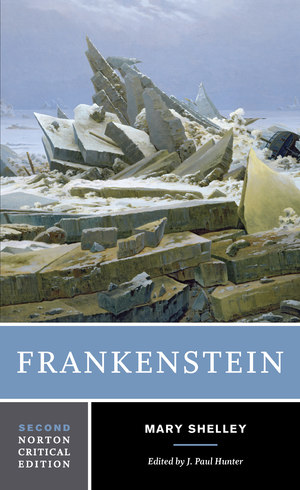
Frankenstein (1818): The Norton Critical Edition

Frankenstein, Second Edition
Norton Critical Editions
Mary Shelley (Author), J. Paul Hunter (Editor, University of Chicago)
http://books.wwnorton.com/books/webad.aspx?id=21895

Paperback
Book Details
Retail: $17.50
December 2011
ISBN: 978-0-393-92793-1
544 pages


Description:

The best-selling student edition on the market, now available in a Second Edition.

Almost two centuries after its publication, Frankenstein remains an indisputably classic text and Mary Shelley’s finest work.

This extensively revised Norton Critical Edition includes new texts and illustrative materials that convey the enduring global conversation about Frankenstein and its author. The text is that of the 1818 first edition, published in three volumes by Lackington, Hughes, Harding, Mavor, and Jones. It is accompanied by an expansive new preface, explanatory annotations, a map of Geneva and its environs, and seven illustrations, five of them new to the Second Edition.

Context is provided in three supporting sections: “Circumstance, Influence, Composition, Revision,” “Reception, Impact, Adaptation,” and “Sources, Influences, Analogues.” Among the Second Edition’s new inclusions are historical-cultural studies by Susan Tyler Hitchcock, William St. Clair, and Elizabeth Young; Chris Baldrick on the novel’s reception; and David Pirie on the novel’s many film adaptations. Related excerpts from the Bible and from John Milton’s Paradise Lost are now included, as is Charles Lamb’s poem “The Old Familiar Faces.”

“Criticism” collects sixteen major interpretations of Frankenstein, nine of them new to the Second Edition. The new contributors are Peter Brooks, Bette London, Garrett Stewart, James. A. W. Heffernan, Patrick Brantlinger, Jonathan Bate, Anne Mellor, Jane Goodall, and Christa Knellwolf.

A Chronology and Selected Bibliography are also included.


Contents

List of Illustrations

Introduction

The Text of Frankenstein

map: Geneva and Its Environs

Title page (1818)

Dedication (1818)

Preface

Frankenstein


Contexts

CIRCUMSTANCE, INFLUENCE, COMPOSITION, REVISION
  • Mary Shelley • Introduction to Frankenstein, Third Edition (1831)
  • John William Polidori • Letter Prefaced to The Vampyre (1819)
  • M. K. Joseph • The Composition of Frankenstein
  • Chris Baldick • [Assembling Frankenstein]
  • Richard Holmes • [Mary Shelley and the Power of Contemporary Science]
  • Christa Knellwolf and Jane Goodall • [The Significance of Place: Ingolstadt]
  • Charles E. Robinson • Texts in Search of an Editor: Reflections on The Frankenstein Notebooks and on Editorial Authority
  • Anne K. Mellor • Choosing a Text of Frankenstein to Teach

RECEPTION, IMPACT, ADAPTATION
  • Percy Bysshe Shelley • On Frankenstein
  • [John Croker] • From the Quarterly Review (January 1818)
  • Sir Walter Scott • From Blackwood’s Edinburgh Magazine (March 1818)
  • Edinburgh Magazine • [On Frankenstein] (March 1818)
  • Gentleman’s Magazine • [On Frankenstein] (April 1818)
  • Knight’s Quarterly • [On Frankenstein] (August–November 1824)
  • Hugh Reginald Haweis • Introduction to the Routledge World Library Edition (1886)
  • Chris Baldick • [The Reception of Frankenstein]
  • William St. Clair • [Frankenstein’s Impact]
  • Susan Tyler Hitchcock • [The Monster Lives On]
  • Elizabeth Young • [Frankenstein as Historical Metaphor]
  • David Pirie • Approaches to Frankenstein [in Film]

SOURCES, INFLUENCES, ANALOGUES
  • The Book of Genesis • [Biblical Account of Creation]
  • John Milton • From Paradise Lost
  • Percy Bysshe Shelley • Mont Blanc (1816)
  • [The Sea of Ice] (1817)
  • Mutability
  • George Gordon, Lord Byron • Prometheus
  • Darkness
  • From Childe Harold’s Pilgrimage, Canto III (1816)
  • Charles Lamb • The Old Familiar Faces 

Criticism

George Levine • Frankenstein and the Tradition of Realism

Ellen Moers • Female Gothic: The Monster’s Mother

Sandra M. Gilbert and Susan Gubar • Mary Shelley’s Monstrous Eve

Mary Poovey • “My Hideous Progeny”: The Lady and the Monster

Anne K. Mellor • Possessing Nature: The Female in Frankenstein

Peter Brooks • What Is a Monster? (According to Frankenstein)

Bette London • Mary Shelley, Frankenstein, and the Spectacle of Masculinity

Marilyn Butler • Frankenstein and Radical Science

Lawrence Lipking • Frankenstein, the True Story; or, Rousseau Judges Jean-Jacques

Garrett Stewart • In the Absence of Audience: Of Reading and Dread in Mary Shelley

James A. W. Heffernan • Looking at the Monster: Frankenstein and Film

Patrick Brantlinger • The Reading Monster

Jonathan Bate • [Frankenstein and the State of Nature]

Anne K. Mellor • Frankenstein, Racial Science, and the Yellow Peril

Jane Goodall • Electrical Romanticism

Christa Knellwolf • Geographic Boundaries and Inner Space: Frankenstein, Scientific Exploration, and the Quest for the Absolute


Mary Shelley: A Chronology

Selected Bibliography


Friedman and Kavey's Monstrous Progeny

Monstrous Progeny: A History of the Frankenstein Narratives
By Lester D. Friedman, Allison B. Kavey
https://www.rutgersuniversitypress.org/monstrous-progeny/9780813564234


256 pages, 37 photographs, 152.4 x 228.6

Paperback,August 1, 2016,$27.95
978-0-8135-6423-4

Cloth Over Boards,August 1, 2016,$90.00
978-0-8135-6424-1

PDF,August 1, 2016,$27.95
978-0-8135-6425-8

EPUB,August 1, 2016,$27.95
978-0-8135-7370-0


About This Book

Mary Shelley’s 1818 novel Frankenstein is its own type of monster mythos that will not die, a corpus whose parts keep getting harvested to animate new artistic creations. What makes this tale so adaptable and so resilient that, nearly 200 years later, it remains vitally relevant in a culture radically different from the one that spawned its birth?

Monstrous Progeny takes readers on a fascinating exploration of the Frankenstein family tree, tracing the literary and intellectual roots of Shelley’s novel from the sixteenth century and analyzing the evolution of the book’s figures and themes into modern productions that range from children’s cartoons to pornography. Along the way, media scholar Lester D. Friedman and historian Allison B. Kavey examine the adaptation and evolution of Victor Frankenstein and his monster across different genres and in different eras. In doing so, they demonstrate how Shelley’s tale and its characters continue to provide crucial reference points for current debates about bioethics, artificial intelligence, cyborg lifeforms, and the limits of scientific progress.

Blending an extensive historical overview with a detailed analysis of key texts, the authors reveal how the Frankenstein legacy arose from a series of fluid intellectual contexts and continues to pulsate through an extraordinary body of media products. Both thought-provoking and entertaining, Monstrous Progeny offers a lively look at an undying and significant cultural phenomenon.


Table of Contents

Acknowledgments

Introduction: Singing the Body Electric

1 In a Country of Eternal Light: Frankenstein’s Intellectual History

2 The Instruments of Life: Frankenstein’s Medical History

3 A More Horrid Contrast: From the Page to the Stage

4 It’s Still Alive: The Universal and Hammer Movie Cycles

5 The House of Frankenstein: Mary Shelley’s Step Children

6 Fifty Ways to Leave Your Monster

Notes

Select Bibliography

Index


About the Authors

LESTER D. FRIEDMAN is a professor and former chair of the Media and Society Program at Hobart and William Smith Colleges in Geneva, New York. He is the author, coauthor, or editor of over twenty books including American Cinema of the 1970s (Rutgers University Press) and the forthcoming, Tough Ain’t Enough.

ALLISON B. KAVEY is an associate professor of early modern history at CUNY John Jay College of Criminal Justice and the CUNY Graduate Center in New York, New York. She is the author, coauthor, or editor of several books including Second Star to the Right: Peter Pan in the Cultural Imagination, co-edited with Friedman (Rutgers University Press).


Sunday, August 13, 2017

Must Read: The Endurance of Frankenstein

The work that begin the discipline of Frankenstein Studies in 1979:

The Endurance of Frankenstein: Essays on Mary Shelley's Novel
George Levine (Editor), U. C. Knoepflmacher (Editor)
http://www.ucpress.edu/book.php?isbn=9780520046405

Available worldwide
Paperback, 362 pages
ISBN: 9780520046405
May 1982
$33.95, £27.95


Description:

MARY SHELLEY's Frankenstein; or, The Modern Prometheus grew out of a parlor game and a nightmare vision. The story of the book's origin is a famous one, first told in the introduction Mary Shelley wrote for the 1831 edition of the novel. The two Shelleys, Byron, Mary's stepsister Claire Clairmont, and John William Polidori (Byron's physician) spent a "wet, ungenial summer in the Swiss Alps." Byron suggested that "each write a ghost story." If one is to trust Mary Shelley's account (and James Rieger has shown the untrustworthiness of its chronology and particulars), only she and "poor Polidori" took the contest seriously. The two "illustrious poets," according to her, "annoyed by the platitude of prose, speedily relinquished their uncongenial task." Polidori, too, is made to seem careless, unable to handle his story of a "skull-headed lady." Though Mary Shelley is just as deprecating when she speaks of her own "tiresome unlucky ghost story," she also suggests that its sources went deeper. Her truant muse became active as soon as she fastened on the "idea" of "making only a transcript of the grim terrors of my waking dream": "'I have found it! What terrified me will terrify others."' The twelve essays in this collection attest to the endurance of Mary Shelley's "waking dream." Appropriately, though less romantically, this book also grew out of a playful conversation at a party. When several of the contributors to this book discovered that they were all closet aficionados of Mary Shelley's novel, they decided that a book might be written in which each contributor-contestant might try to account for the persistent hold that Frankenstein continues to exercise on the popular imagination. Within a few months, two films--Warhol's Frankenstein and Mel Brooks's Young Frankenstein--and the Hall-Landau and Isherwood-Bachardy television versions of the novel appeared to remind us of our blunted purpose. These manifestations were an auspicious sign and resulted in the book Endurance of Frankenstein.


Contents:

Detailed contents list from WorldCat (http://www.worldcat.org/title/endurance-of-frankenstein-essays-on-mary-shelleys-novel/oclc/5133230), the press's website only presents the major sections.

List of Illustrations

Preface

Mary Wollstonecraft Godwin Shelley and Frankenstein: A Chronology

[Part I. Traditions : looking forwards and backwards] Ambiguous heritage of Frankenstein / George Levine. Frankenstein as mystery play / Judith Wilt. Fire and ice in Frankenstein / Andrew Griffin --

[Part II. Biographical soundings : of mothers and daughters] Female Gothic / Ellen Moers. Thoughts on the aggression of daughters / U.C. Knoepflmacher --

[Part III. Contexts : society and self] Monsters in the garden : Mary Shelley and the bourgeois family / Kate Ellis. Mary Shelley's monster : politics and psyche in Frankenstein / Lee Sterrenburg. Vital artifice : Mary, Percy, and the psychopolitical integrity of Frankenstein / Peter Dale Scott --

[Part IV. Texture : language and the grotesque] "Godlike science / unhallowed arts" : language, nature and monstrosity / Peter Brooks. Frankenstein and comedy / Philip Stevick --

[Part V. Visual progeny : drama and film] Stage and film children of Frankenstein : a survey / Albert J. Lavalley. Coming to life : Frankenstein and the nature of film narrative / William Nestrick.

Appendix: "Face to face" : of man-apes, monsters, and readers.

Contributors
Selected Annotated Bibliography
Index

Essential Resource: Approaches to Teaching Shelley’s Frankenstein

Approaches to Teaching Shelley’s Frankenstein
Editor: Stephen C. Behrendt
https://www.mla.org/Publications/Bookstore/Approaches-to-Teaching-World-Literature/Approaches-to-Teaching-Shelley-s-Frankenstein

Pages: x & 190 pp.
Published: 1990
Approaches to Teaching World Literature
ISBN: 9780873525398 (Cloth)
ISBN: 9780873525404 (Paperback)


Description

Mary Shelley’s Frankenstein is both a literary work very much rooted in its age and a cultural artifact that transcends period. “Undeniably one of the great and influential works of the English Romantic period,” writes the editor, Stephen C. Behrendt, the novel provides “an excellent vehicle for introducing students to the complexities of Romantic art and thought.” At the same time, as this volume demonstrates, Frankenstein is often studied in college and secondary school courses focusing not on Romanticism but on science fiction, Gothic fiction, women’s literature, or film and popular culture.

The book, like others in the MLA’s Approaches to Teaching World Literature series, is divided into two parts. The first part, “Materials,” reviews editions of Frankenstein, discusses reference and critical works and recommended reading for students, and lists selected film versions of the novel. In the second part, “Approaches,” instructors present classroom strategies for teaching the novel. The essays are divided into four groupings: general issues (e.g., choosing a text, gender and pedagogy, language and style), contexts of study (e.g., biography, Romanticism), course contexts (e.g., science fiction, women’s studies, composition), and Frankenstein and film.


No contents list available.


Tuesday, July 11, 2017

Frankenstein Editions: 1818 in Oxford World's Classics Series

Frankenstein, or The Modern Prometheus: The 1818 Text
By Mary Shelley
Edited with an introduction by Marilyn Butler
Oxford World's Classics
https://global.oup.com/academic/product/frankenstein-or-the-modern-prometheus-9780199537150?lang=en&cc=us#

Paperback ($8.95)
Published: 01 May 2009
328 Pages
ISBN: 9780199537150


Key features
  • Based on the harder and wittier 1818 version of the text. 
  • Draws on new research and examines the novel in the context of the controversial radical sciences developing in the years following the Napoleonic Wars. 
  • Shows the relationship of Frankenstein's experiment to the contemporary debate between champions of materialistic science and proponents of received religion.
 
Description 
 
Shelley's enduringly popular and rich gothic tale, Frankenstein, confronts some of the most feared innovations of evolutionism and science--topics such as degeneracy, hereditary disease, and humankind's ability to act as creator of the modern world. This new edition, based on the harder and wittier 1818 version of the text, draws on new research and examines the novel in the context of the controversial radical sciences developing in the years following the Napoleonic Wars. In addition it shows the relationship of Frankenstein's experiment to the contemporary debate between champions of materialistic science and proponents of received religion.


Frankenstein Editions: 1831 Edition in Oxford World's Classics

Continuing to get information on all standard editions of Frankenstein into the blog. Here is the first of two from Oxford University Press.

Frankenstein, or The Modern Prometheus
By Mary Shelley
Edited with an Introduction and Notes by the late M. K. Joseph
Oxford World's Classics
264 Pages
6-1/8 x 9-1/4 inches
ISBN: 9780199537167

Also Available As: Ebook


Shelley's suspenseful and intellectually rich gothic tale confronts some of the most important and enduring themes in all of literature--the power of human imagination, the potential hubris of science, the gulf between appearance and essence, the effects of human cruelty, the desire for revenge and the need for forgiveness, and much more.


Frankenstein at the Huntington

The Huntington Library, Art Collections, and Botanical Gardens in San Marino, California, includes the following event on its calendar (http://www.huntington.org/WebAssets/Templates/content.aspx?id=11160) for 2018. Further details will be posted as they become available.

May 11-12, 2018
Frankenstein Then and Now, 1818-2018
Conveners: Jerrold Hogle (University of Arizona) and Anne Mellor (UCLA)

Fisch's Frankenstein: Icon of Modern Culture

The looks comparable to Hitchcock's book in term of offering a comprehensive history of the Frankenstein tradition, but the sections are broken into smaller units and (I think) it has more illustrations. Sadly, it appears out of print. 

Frankenstein: Icon of Modern Culture
http://www.helm-information.co.uk/frankenstein.htm
Audrey A. Fisch
Series: Icons of Modern Culture

Helm Information


Books details:

978-1-903206-20-1
320pp
55 illustrations
RRP £38
April 2009


Description:

This is the fifth book in the Icons of Modern Culture series. Children and adults the world over know the lumbering, overlarge figure with the green face and bolts in his head. How did the Halloween staple known as "Frankenstein" emerge out of the anonymous novel by a "young girl," published in 1818 to mixed reviews? The answer, as this study makes clear, is that the "Frankenstein" we know today is not solely Mary Shelley’s progeny. "Frankenstein" morphed into many different forms over time, place, and genre. This volume displays and analyses the many post-Shelley "Frankensteins," exploring their continuities and disjunctions in order to trace the development of this enduring icon. The volume also traces the complex history of Mary Shelley’s Frankenstein, including its publishing history, its dismissal by the literary establishment, and its subsequent reclamation as a touchstone text in high school and college classrooms. Students of Shelley’s novel or of the many "Frankensteins" her novel propagated will find here an analysis of this intriguing cultural history. This volume also provides extensive extracts, gathering together an unprecedented collection of both never-before published and previously published material, so that readers can read widely and develop their own sense of "Frankenstein’s" place in our world.


Table of Contents:


List of Illustrations

Acknowledgements

Series Editor’s Preface


Introduction


Section 1 – Mary Shelley and the first "Frankensteins"

1. Publication

2. Frankenstein, Godwin, and Wollstonecraft

3. Reception

4. Early Science

5. The Nature of Man

6. Percy Shelley and Frankenstein

7. Mary Shelley and Frankenstein

8. Revision and Authorship


Section 2 – Beyond Mary Shelley

9. Early Theatre 1823–1826

10. Victorian Burlesque-Extravaganza

11. Other Victorian "Frankensteins"

12. Silent Film

13. Early Twentieth-Century Drama

14. Whale, Hammer, and Beyond

15. Feminist Canonisation

16. Critical Progeny

17. The Scientific Legacy of "Frankenstein"

18. Contemporary "Frankenstein"


Conclusion: Ubiquitous "Frankenstein"


Appendix: "The Death Bride" from Tales of the Dead


Bibliography


Index


About the author:

Audrey A. Fisch is Professor of English and Coordinator of Secondary English Education at New Jersey City University. She is the editor of The Other Mary Shelley: Beyond Frankenstein and The Cambridge Companion to the African American Slave Narrative and the author of American Slaves in Victorian England: Abolitionist Politics in Popular Literature and Culture.

Cambridge Companion to Mary Shelley

A great overview of Mary Shelley and her writings. It includes a number of pieces on Frankenstein and the Frankenstein tradition:

The Cambridge Companion to Mary Shelley
http://www.cambridge.org/us/academic/subjects/literature/english-literature-1700-1830/cambridge-companion-mary-shelley
Part of Cambridge Companions to Literature
Editor: Esther Schor, Princeton University, New Jersey

Product details

Date Published: January 2004
format: Paperback
isbn: 9780521007702
length: 316 pages
dimensions: 229 x 154 x 21 mm
weight: 0.52kg
contains: 14 b/w illus.

$ 30.99 (Paperback )
Other available formats:Hardback, eBook


Description

Well-known scholars review Mary Shelley's work in several contexts (literary history, aesthetic and literary culture, the legacies of her parents) and also analyze her most famous work-- Frankenstein. The contributors also examine Shelley as a biographer, cultural critic, and travel writer. The text is supplemented by a chronology, guide to further reading and select filmography.

  • Covers a wide range of topics in a clear and comprehensive way
  • The volume is well supported by a detailed chronology, bibliography and select filmography
  • Offers treatments of film and popular culture in addition to literary and cultural criticism approaches


Table of Contents

Chronology

Introduction Esther Schor (online)

Part I. 'The Author of Frankenstein':
1. Making a 'monster': an introduction to Frankenstein Anne K. Mellor (online)
2. Frankenstein, Matilda, and the legacies of Godwin and Wollstonecraft Pamela Clemit
3. Frankenstein, feminism, and literary theory Diane Long Hoeveler
4. Frankenstein on Film Esther Schor
5. Frankenstein's futurity: from replicants to robotics Jay Clayton


Part II. Fictions and Myths:
6. Valperga Stuart Curran
7. The last man Kari E. Lokke
8. Historical novelist Deidre Lynch
9. Falkner and other fictions Kate Ferguson Ellis
10. Stories for the Keepsake Charlotte Sussman
11. Proserpine and Midas Judith Pascoe

Part III. Professional Personae:
12. Mary Shelley, editor Susan J. Wolfson
13. Letters: the public/private self Betty T. Bennett
14. Mary Shelley as biographer Greg Kucich
15. Mary Shelley's travel writing Jeanne Moskal
16. Mary Shelley as cultural critic Timothy Morton

Further reading

Selected filmography.

Must Read: Hitchcock's Frankenstein: A Cultural History

A masterful survey of the Frankenstein tradition:

Frankenstein:A Cultural History
By Susan Tyler Hitchcock
W. W. Norton
http://books.wwnorton.com/books/978-0-393-06144-4/

Book Details
Hardcover
October 2007
ISBN 978-0-393-06144-4
5.9 × 8.5 in / 400 pages

Sales Territory: Worldwide including Canada, but excluding the British Commonwealth.


Overview

A lively history of the Frankenstein myth, tracing its evolution from a Romantic nightmare to its prominence in today's imaginative landscape.

Frankenstein began as the nightmare of an unwed teenage mother in Geneva, Switzerland, in 1816. At a time when the moral universe was shifting and advances in scientific knowledge promised humans dominion over that which had been God's alone, Mary Shelley envisioned a story of human presumption and its misbegotten consequences. Two centuries later, that story is still constantly retold and reinterpreted, from Halloween cartoons to ominous allusions in the public debate, capturing and conveying meaning central to our consciousness today and our concerns for tomorrow. From Victorian musical theater to Boris Karloff with neck bolts, to invocations at the President's Council on Bioethics, the monster and his myth have inspired everyone from cultural critics to comic book addicts. This is a lively and eclectic cultural history, illuminated with dozens of pictures and illustrations, and told with skill and humor. Susan Tyler Hitchcock uses film, literature, history, science, and even punk music to help us understand the meaning of this monster made by man.


Contents (from WorldCat)

Conception --
Birth and lineage --
Reception and revision --
The monster lives on --
Making more monsters --
A monster for modern times --
A brave new world of monsters --
The horror and the humor --
Monsters in the living room --
Taking the monster seriously --
The monster and his myth today.


Monday, July 10, 2017

Frankenstein (3rd Edition) from Bedford/St Martin's

Frankenstein (Case Study in Contemporary Criticism)
Third Edition ©2016
http://www.macmillanlearning.com/Catalog/product/frankenstein-thirdedition-shelley#tab

By Mary Shelley , edited by Johanna M. Smith (University of Texas at Arlington)

ISBN-10: 0-312-46318-9; ISBN-13: 978-0-312-46318-2; Format: Paper Text, 608 pages

A long-awaited revision of the bestselling Case Study in Contemporary Criticism: Frankenstein

Revised to reflect critical trends of the past 15 years, the third iteration of this widely adopted critical edition presents the 1831 text of Mary Shelley’s English Romantic novel along with critical essays that introduce students to Frankenstein from contemporary psychoanalytic, Marxist, feminist, gender/queer, postcolonial, and cultural studies perspectives. The text and essays are complemented by contextual documents, introductions (with bibliographies), and a glossary of critical and theoretical terms.

In the third edition, three of the six essays are new, representing recent gender/queer, postcolonial, and cultural theories. The contextual documents have been significantly revised to include many images of Frankenstein from contemporary popular culture.


Features:
  • An authoritative text of Frankenstein (1831)
  • Exemplary essays about Frankenstein representing contemporary critical approaches
  • A rich selection of cultural contextual documents
  • Highly praised editorial matter, including biographical and critical introductions, bibliographies, and a glossary

New to this edition:
  • Three new critical essays representing recent gender/queer, postcolonial, and cultural theories
  • Expanded collection of contextual documents and illustrations, including images of Frankenstein from contemporary popular culture
  • Updated editorial apparatus

Contents:

Part One Frankenstein: The Complete Text in Cultural Context

Biographical and Historical Contexts

The Complete Text

Part Two Frankenstein in Cultural Context

Part Three Frankenstein: A Case Study in Contemporary Criticism

A Critical History of Frankenstein

Psychoanalytic Criticism and Frankenstein
David Collings, “The Monster and the Maternal Thing: Mary Shelley’s Critique of Ideology”

Feminist Criticism and Frankenstein
Johanna M. Smith, “’Cooped Up” with “Sad Trash”: Domesticity and the Sciences in Frankenstein

Marxist Criticism and Frankenstein
Warren Montag, “’The Workshop of Filthy Creation’: A Marxist Reading of Frankenstein

Gender Criticism/Queer Theory and Frankenstein
New Grant F. Scott, “Victor’s Secret: Queer Gothic in Lynd Ward’s Illustrations to Frankenstein (1934)”

Cultural Criticism and Frankenstein
New Siobhan Carroll, “Crusades Against Frost: Frankenstein, Polar Ice, and Climate Change in 1818”

Postcolonial Criticism and Frankenstein
New Allan Lloyd Smith, “’This Thing of Darkness’: Racial Discourse in Mary Shelley’s Frankenstein

Glossary of Critical and Theoretical Terms


About the editor:

Johanna M. Smith is an Associate Professor of English at the University of Texas at Arlington, where she teaches drama, law and literature, and eighteenth- and nineteenth-century British literature. She has published numerous articles in the latter fields, as well as a Twayne guide to Mary Shelley and a coedited anthology of eighteenth-century British women's life writings. Her current research focus is British women in the public sphere from the mid-eighteenth to the mid-nineteenth century.


Frankenstein from MIT Press

Frankenstein: Annotated for Scientists, Engineers, and Creators of All Kinds
https://mitpress.mit.edu/books/frankenstein

By Mary Shelley
Edited by David H. Guston, Ed Finn and Jason Scott Robert
Introduction by Charles E. Robinson


Paperback | $19.95 Trade | £14.95 | 320 pp. | 6.5 x 9 in | May 2017 | ISBN: 9780262533287

eBook | $19.95 Trade | April 2017 | ISBN: 9780262340250
Overview

Mary Shelley’s Frankenstein has endured in the popular imagination for two hundred years. Begun as a ghost story by an intellectually and socially precocious eighteen-year-old author during a cold and rainy summer on the shores of Lake Geneva, the dramatic tale of Victor Frankenstein and his stitched-together creature can be read as the ultimate parable of scientific hubris. Victor, “the modern Prometheus,” tried to do what he perhaps should have left to Nature: create life. Although the novel is most often discussed in literary-historical terms—as a seminal example of romanticism or as a groundbreaking early work of science fiction—Mary Shelley was keenly aware of contemporary scientific developments and incorporated them into her story. In our era of synthetic biology, artificial intelligence, robotics, and climate engineering, this edition of Frankenstein will resonate forcefully for readers with a background or interest in science and engineering, and anyone intrigued by the fundamental questions of creativity and responsibility.

This edition of Frankenstein pairs the original 1818 version of the manuscript—meticulously line-edited and amended by Charles E. Robinson, one of the world’s preeminent authorities on the text—with annotations and essays by leading scholars exploring the social and ethical aspects of scientific creativity raised by this remarkable story. The result is a unique and accessible edition of one of the most thought-provoking and influential novels ever written.

Essays by
Elizabeth Bear, Cory Doctorow, Heather E. Douglas, Josephine Johnston, Kate MacCord, Jane Maienschein, Anne K. Mellor, Alfred Nordmann


CONTENTS (contents listing derived from JSTOR: https://www.jstor.org/stable/j.ctt1pk3jfp)


     Front Matter
    (pp. i-vi)

    Table of Contents
    (pp. vii-ix)
   
 
    EDITORS’ PREFACE
    (pp. x-xix)
    DAVID H. GUSTON, ED FINN and JASON SCOTT ROBERT
   
    ACKNOWLEDGMENTS
    (pp. xx-xxi)
   
    INTRODUCTION
    (pp. xxii-xxxvi)
    CHARLES E. ROBINSON

 
    FRANKENSTEIN OR, THE MODERN PROMETHEUS

        VOLUME I
        (pp. xxxviii-69)

        VOLUME II
        (pp. 70-125)

        VOLUME III
        (pp. 126-188)

         INTRODUCTION TO FRANKENSTEIN (1831)
        (pp. 189-194)

        CHRONOLOGY OF SCIENCE AND MARY WOLLSTONECRAFT SHELLEY
        (pp. 195-198)
 
    ESSAYS

        TRAUMATIC RESPONSIBILITY: VICTOR FRANKENSTEIN AS CREATOR AND CASUALTY
        (pp. 201-208)
        JOSEPHINE JOHNSTON

        I’VE CREATED A MONSTER! (AND SO CAN YOU)
        (pp. 209-214)
        CORY DOCTOROW

        CHANGING CONCEPTIONS OF HUMAN NATURE
        (pp. 215-222)
        JANE MAIENSCHEIN and KATE MACCORD

        UNDISTURBED BY REALITY: VICTOR FRANKENSTEIN’S TECHNOSCIENTIFIC DREAM OF REASON
        (pp. 223-230)
        ALFRED NORDMANN

        FRANKENSTEIN REFRAMED; OR, THE TROUBLE WITH PROMETHEUS
        (pp. 231-238)
        ELIZABETH BEAR

        FRANKENSTEIN, GENDER, AND MOTHER NATURE
        (pp. 239-246)
        ANNE K. MELLOR

        THE BITTER AFTERTASTE OF TECHNICAL SWEETNESS
        (pp. 247-252)
        HEATHER E. DOUGLAS


    APPENDIXES

        REFERENCES
        (pp. 255-260)
  
        FURTHER READING
        (pp. 261-262)
    
        DISCUSSION QUESTIONS
        (pp. 263-274)
 
        CONTRIBUTORS
        (pp. 275-281)
    
    Back Matter
    (pp. 282-282)
    

About the Editors

David Guston is Professor and Founding Director of the School for the Future of Innovation in Society at Arizona State University, where he also serves as Codirector of the Consortium for Science, Policy, and Outcomes..

Ed Finn is Founding Director of the Center for Science and the Imagination at Arizona State University, where he is also Assistant Professor with a joint appointment in the School of Arts, Media, and Engineering and the Department of English.

Jason Scott Robert is Lincoln Chair in Ethics, Associate Professor in the School of Life Sciences, and Director of the Lincoln Center for Applied Ethics at Arizona State University.

Klinger's The New Annotated Frankenstein due August 2017

The New Annotated Frankenstein
http://books.wwnorton.com/books/978-0-87140-949-2/

Mary Shelley (Author), Leslie S. Klinger (Editor)

With an Introduction by Guillermo del Toro, With an Afterword by Anne K. Mellor

A Liveright book

Book Details

Retail Price: $35.00
Hardcover
Forthcoming August 2017
ISBN 978-0-87140-949-2
8.9 × 10.3 in / 432 pages
Sales Territory: Worldwide


Two centuries after its original publication, Mary Shelley’s classic tale of gothic horror comes to vivid life in "what may very well be the best presentation of the novel" to date (Guillermo del Toro).

"Remarkably, a nineteen-year-old, writing her first novel, penned a tale that combines tragedy, morality, social commentary, and a thoughtful examination of the very nature of knowledge," writes best-selling author Leslie S. Klinger in his foreword to The New Annotated Frankenstein. Despite its undeniable status as one of the most influential works of fiction ever written, Mary Shelley’s novel is often reductively dismissed as the wellspring for tacky monster films or as a cautionary tale about experimental science gone haywire. Now, two centuries after the first publication of Frankenstein, Klinger revives Shelley’s gothic masterpiece by reproducing her original text with the most lavishly illustrated and comprehensively annotated edition to date.

Featuring over 200 illustrations and nearly 1,000 annotations, this sumptuous volume recaptures Shelley’s early nineteenth-century world with historical precision and imaginative breadth, tracing the social and political roots of the author’s revolutionary brand of Romanticism. Braiding together decades of scholarship with his own keen insights, Klinger recounts Frankenstein’s indelible contributions to the realms of science fiction, feminist theory, and modern intellectual history—not to mention film history and popular culture. The result of Klinger’s exhaustive research is a multifaceted portrait of one of Western literature’s most divinely gifted prodigies, a young novelist who defied her era’s restrictions on female ambitions by independently supporting herself and her children as a writer and editor.

Born in a world of men in the midst of a political and an emerging industrial revolution, Shelley crafted a horror story that, beyond its incisive commentary on her own milieu, is widely recognized as the first work of science fiction. The daughter of a pioneering feminist and an Enlightenment philosopher, Shelley lived and wrote at the center of British Romanticism, the “exuberant, young movement” that rebelled against tradition and reason and "with a rebellious scream gave birth to a world of gods and monsters" (del Toro).

Following his best-selling The New Annotated H. P. Lovecraft and The New Annotated Sherlock Holmes, Klinger not only considers Shelley’s original 1818 text but, for the first time in any annotated volume, traces the effects of her significant revisions in the 1823 and 1831 editions. With an afterword by renowned literary scholar Anne K. Mellor, The New Annotated Frankenstein celebrates the prescient genius and undying legacy of the world’s "first truly modern myth."

The New Annotated Frankenstein includes:
  • Nearly 1,000 notes that provide information and historical context on every aspect of Frankenstein and of Mary Shelley’s life
  • Over 200 illustrations, including original artwork from the 1831 edition and dozens of photographs of real-world locations that appear in the novel
  • Extensive listings of films and theatrical adaptations
  • An introduction by Guillermo del Toro and an afterword by Anne K. Mellor