Celebrating in 2026: the 105th anniversary of the lost film Il Mostro di Frankenstein (1921); the 95th anniversary of Universal Studios’ Frankenstein (1931); the 60th anniversary of Dell Comics’ superhero version of Frankenstein (1966), Hanna Barbera’s television hero Frankenstein Jr, co-star of the series Frankenstein Jr. and The Impossibles (1966), and the films Jesse James Meets Frankenstein's Daughter (1966) and The War of the Gargantuas (1966); the 55th anniversary of General Mills’ cereal mascot Franken Berry (1971); the 50th anniversary of the Saturday-morning television series Monster Squad (1976); the 45th anniversary of the anime film Kyofu Densetsu: Kaiki! Furankenshutain (1981); the 40th anniversary of Ken Russell’s film Gothic (1986) and Fred Saberhagen’s novel The Frankenstein Papers (1986); the 25th anniversary of Curtis Jobling’s picture book Frankenstein's Cat (2001); the 20th anniversary of Grant Morrision’s comic book series Seven Soldiers: Frankenstein (2006); the 15th anniversary of Nick Dear’s play Frankenstein (2011); the 10th anniversary of the Royal Ballet's production of Frankenstein (2016); and the release of Maggie Gyllenhaal’s film Bride! (2026).
Showing posts with label Drama. Show all posts

Sunday, October 26, 2025

UPDATE Frankensteinian Resonance: Transtemporal Reanimations in Fiction, Film, and Video (11/30/2025)

Updated CFP. Please note, this call has educational restrictions for applicants.

FRANKENSTEINIAN RESONANCE: Transtemporal Reanimations in Fiction, Film, and Video


deadline for submissions:
November 30, 2025

full name / name of organization:
Assoc. Prof. Ela İpek Gündüz, Gaziantep University, Turkey & Dr. Ercan Gürova, Ankara University, Turkey

contact email:
frankensteinianresonance@gmail.com

source: https://call-for-papers.sas.upenn.edu/cfp/2025/07/29/frankensteinian-resonance-transtemporal-reanimations-in-fiction-film-and-video


Call for Book Chapters

Frankensteinian Resonance: Transtemporal Reanimations in Fiction, Film, and Video

“Under Strong Interest” by Palgrave Macmillan

Editors’ Introduction

Considering the still resonating waves of Mary Shelley’s timeless novel Frankenstein; or the Modern Prometheus (1818), due to its conveying the notions, issues, and messages which are both relevant to current times, and as a reflection of its own time, ‘Frankenstein’ continues to be a very appealing trope, phenomenon or myth. The very idea of “humaneness” is speculated continuously due to the embeddedness of the “Frankenstein” the creator, the monster, and the novel itself, including its writer, within the literary and cultural landscape. It is an undeniable fact that it has been perpetually remembered and reinvented due to its uniqueness, even in the 21st century, prompting producers to adapt it. Yet, how it affects, appeals to, finds correspondences with, and elicits reactions or appreciations may be varied. Nevertheless, regardless of this differentiation in both the re-handlings and/or remembering, as well as the responses, the very speciality of the text remains visible. Notwithstanding the conventions of the genres or the adaptation mediums, as a very special text, Frankenstein transgresses the socio-cultural and even spatio-temporal boundaries that pave the way for the appreciation of contemporary readers and/or audiences.

The proposed edited volume, Frankensteineian Resonance: Transtemporal Reanimations in Fiction, Film, and Video, seeks to provide a rigorous, interdisciplinary exploration of how the Frankenstein mythos continues to evolve, adapt, and resonate across contemporary media landscapes. The volume thus proposes Frankenstein as a transtextual and transtemporal entity, a metaphorical conduit through which trauma, memory, identity, and otherness are endlessly renegotiated. It examines how contemporary rewritings and adaptations, spanning various genres and platforms, reveal the persistence of Frankensteinian concerns with artificial life, the ethics of creation, and the blurred boundaries between human and nonhuman. By assembling approximately 20 original chapters that analyse iconic novels, films, video games, and theatrical adaptations through transtemporal lenses, this collection aims to contribute to Gothic studies, adaptation theory, science fiction criticism, and broader discussions on the posthuman condition. Contributions will be selected through an open international call targeting scholars in literature, film, and cultural studies with PhDs or equivalent credentials.

Each contributor will offer a close and original analysis of a novel, film, or media work that actively reimagines the Frankenstein myth. Rather than adopting a purely descriptive approach, each chapter will develop a coherent and critical argument, connecting the selected work to key interpretive frameworks, such as monstrosity, hybridity, technological creation, identity fragmentation, and moral ambiguity.

Contributors will be asked to choose a specific fictional or cinematic text and engage it through relevant theoretical and cultural lenses. While the exact titles and authors of the chapters will be finalised after the acceptance of proposals, all chapters will be unified by the volume’s overarching interest in Frankenstein as a resonant, reconfigurable myth that speaks to evolving human concerns.

Please choose one of the topics listed below as the focus of your chapter. Proposals should clearly identify the selected work (novel, film, or media) and your theoretical framework.


Part I - Literary Re-Visitations/ Rewritings

1-Frankenstein Unbound (1973) by Brian W. Aldiss

2-The Frankenstein Papers (1986) by Fred Saberhagen

3-Poor Things (1992) by Alasdair Gray [Accepted]

4-The Memoirs of Elizabeth Frankenstein (1995) by Theodore Roszak [Accepted]

5-The Casebook of Victor Frankenstein (2008) by Peter Ackroyd

6-Frankenstein in Baghdad (2013) by Ahmed Saadawi

7-Frankissstein: A Love Story (2019) by Jeanette Winterson[Accepted]

8-Heart of a Dog (1925) by Mikhail Bulgakov [Accepted]

9-Golem (1915) by Gustav Meyrink

10-The Sandman (1816) by E.T.A Hoffmann


Part II- Movie/ Theatre/Video Game Adaptations


1-Frankenstein (1931) & Bride of Frankenstein (1935) – Dir. James Whale

2-The Curse of Frankenstein (1957) – Dir. Terence Fisher [Accepted]

3-Young Frankenstein (1974) – Dir. Mel Brooks[Accepted]

4-Mary Shelley’s Frankenstein (1994) – Dir. Kenneth Branagh

5-Frankenstein (2004) – Dir. Marcus Nispel

6-Victor Frankenstein (2015) – Dir. Paul McGuigan [Accepted]

7-Frankenstein (2015) – Dir. Bernard Rose

8-The Frankenstein Chronicles (2015–2017) – ITV Series

9-Frankenstein (1981) – by Victor Gialanella

10-Frankenstein – Playing with Fire (1988) – by Barbara Field

11-Frankenstein (2007) – by Nick Dear, directed by Danny Boyle

12-Frankenstein (2017) a musical theatre adaptation by Eric B. Sirota

13-Frankenstein: Through the Eyes of the Monster (1995)

14-Frankenstein: Master of Death (2015)

15-Frankenstein: Beyond the Time (2016)

16-Frankenstein Wars (2017)

17-Poor Things (2023)


Submission Details and Timeline

Please send a 300–500 word abstract describing the proposed chapter’s theory/framework, contributions, and structure, and a brief bio (100–150 words) to frankensteinianresonance@gmail.com

The abstract submission deadline is November 30, 2025.

Submission of Complete Chapters (for selected abstracts): March 30, 2026.

Final chapters will be expected to be around 5500-6000 words, in English, and referenced in MLA 9 style.

The book is expected to be published in late 2026, following peer review and editorial revisions.

All submissions will undergo a rigorous double-blind peer-review process.

For inquiries and questions, please feel free to contact us at frankensteinianresonance@gmail.com


Editors: Assoc. Prof. Ela İpek Gündüz, Gaziantep University, Turkey

Dr. Ercan Gürova, Ankara University, Turkey


Last updated October 24, 2025

Monday, June 3, 2024

New from Bloomsbury Academic - Peggy Webling and the Story behind Frankenstein: The Making of a Hollywood Monster

Peggy Webling and the Story behind Frankenstein: The Making of a Hollywood Monster

Peggy Webling (Author) , Dorian Gieseler Greenbaum (Author) , Bruce Graver (Author)


Ordering information available at https://www.bloomsbury.com/us/peggy-webling-and-the-story-behind-frankenstein-9781350371651/. Available in print (hardcover and paperback) and as an ebook. 


Product details

Published Apr 18 2024

Edition 1st

Extent 344

Imprint Bloomsbury Academic

Illustrations 15 bw illus

Dimensions 9 x 6 inches

Publisher Bloomsbury Publishing


Description

The 1931 Universal Pictures film adaptation of Frankenstein directed by James Whale and starring Boris Karloff as the now iconic Monster claims in its credits to be 'Adapted from the play by Peggy Webling'.


Webling's play sought to humanize the creature, was the first stage adaptation to position Frankenstein and his creation as doppelgängers, and offered a feminist perspective on scientific efforts to create life without women, ideas that suffuse today's perceptions of Frankenstein's monster. The original play script exists in several different versions, only two of which have ever been consulted by scholars; no version has ever been published. Nor have scholars had access to Webling's private papers and correspondence, preserved in a family archive, so that the evolution of Frankenstein from book to stage to screen has never been fully charted.


In Peggy Webling and the Story behind Frankenstein, Dorian Gieseler Greenbaum (Webling's great grandniece) and Bruce Graver present the full texts of Webling's unpublished play for the first time. A vital critical edition, this book includes:


- the 1927 British Library Frankenstein script used for the first production of the play in Preston, Lancashire

- the 1928 Frankenstein script in the Library of Congress, used for productions in UK provincial theatres from autumn 1928 till 1930

- the 1930 Frankenstein Prompt Script for the London production and later provincial performances, held by the Westminster Archive, London

- Webling's private correspondence including negotiations with theatre managers and Universal Pictures, family letters about the writing and production process, and selected contracts

- Text of the chapter 'Frankenstein' from Webling's unpublished literary memoir, The Story of a Pen for additional context

- Biography of Webling that bears directly on the sensibilities and skills she brought to the writing of her play

- History of how the play came to be written and produced

- The relationship of Webling's play to earlier stage and film adaptations

- An exploration of playwright and screenwriter John L. Balderston's changes to Webling's play and Whale's borrowings from it in the 1931 film


Offering a new perspective on the genesis of the Frankenstein movie, this critical exploration makes available a unique and necessary 'missing link' in the novel's otherwise well-documented transmedia cultural history.


Table of Contents

List of Illustrations

Acknowledgements

Introduction

Part I History and Commentary


Chapter 1 Peggy Webling's Story


Chapter 2 The Other Woman who Created Frankenstein


Chapter 3 From Peake to Whale, and Webling's Missing Link


Part II Texts of Webling's Frankenstein


1927 Version, registered with the Lord Chamberlain on 25 November 1927


1928 Version, copyrighted with the US Library of Congress on 7 September 1928


1930 Prompt Script, performed in London 10 February–12 April 1930


Appendix 1 Excerpts from Webling Letters concerning Frankenstein


Appendix 2 Excerpt from Webling's Unpublished Memoir, The Story of a Pen


Appendix 3 Contracts


Bibliography General Bibliography

Sources from the Webling Archive

Index


Author Information

Peggy Webling (1 January 1871 – 27 June 1949) was a British playwright, novelist and poet.

Dorian Gieseler Greenbaum is a historian specialising in the history of astrology, cosmology and divination. She is the great-grandniece of Peggy Webling, the playwright, and holds a private archive of her papers. She has lectured on the history of Webling’s Frankenstein for specialists and general audiences.

Bruce Graver is Professor of English at Providence College, USA where is a specialist in British Romantic literature. He edited Wordsworth’s Translations of Chaucer and Virgil (1998), co-edited Wordsworth and Coleridge’s Lyrical Ballads (2003), and contributed many chapters to edited collections as well as writing and lecturing widely about various British Romantic writers, including Mary Shelley.

Sunday, August 27, 2023

Out Now - New Edition of The Frankenstein Legend


First published in 1973, The Frankenstein Legend: A Tribute to Mary Shelley and Boris Karloff, written by Donald F. Glut, has recently been re-issued in a second edition (published by Strange Particle Press in 2022). The work covers Shelley's novel and its adaptation on stage and screen (both film and television), for radio, in fiction, and as comics. 

Comprising over 400 pages, much of the content is repeated from the original edition, but Glur has included new and/or updated images to accompany the text. In addition, Glut adds a new illustrated afterword that provides updates to various sections of the text. 


I couldn't find a direct link for Strange Particle Press, but the book can be purchased from various online booksellers as print-on-demand and electronic versions. 


Monday, November 29, 2021

Out Now: Frankenstein and Its Environments, Then and Now edited by Jerrold E. Hogle

Another new collection of essays on Frankenstein. Details copied from H-Albion at https://networks.h-net.org/node/16749/discussions/7631521/toc-huntington-library-quarterly
 
The issue can be accessed from Project MUSE at https://muse.jhu.edu/issue/44365 and/or via the links provided (if you have institutional access) or purchased direct from the publisher, University of Pennsylvania Press, for $20 at https://hlq.pennpress.org/home/.


Huntington Library Quarterly Volume 83.4  Winter 2020

Special Issue: Frankenstein and Its Environments, Then and Now 

Edited by Jerrold E. Hogle


ARTICLES
 
 
This prolegomenon to a collection of eleven essays provides a setting for them all by explaining the ongoing significance of Mary Shelley’s original Frankenstein two hundred years after it was first published; the theme of multiple “environments” that imbues Frankenstein and its offshoots and that is common to all these essays; the novel’s emergence from a generic environment of fiction (the Gothic) that established itself in the 1760s and continues to this day; the history of interpretations of Frankenstein generated by the various theoretical environments in which it has been analyzed; and how all of the following essays, including the particular environments of Frankenstein they treat, both advance that history and fit into the overall scheme of this special issue.
 
 
Of Frankenstein; or, The Modern Prometheus—as the or (appositive or alternative?) may suggest—origins are in such oversupply, such over-determination, as to make a question of origin itself. Its complex multiples extend to a report from the decade in which Frankenstein is cast, the 1790s: J. M. Itard’s De l’éducation d’un homme sauvage (1801), about a feral boy of mysterious origin. Susan Wolfson investigates the several origin-stories for, in, from, and around Mary Shelley’s durably dynamic novel, including the question of “monstrous” assignments and the riddle for Enlightenment thought about whether primitive existence is ideal innocence, or savagery.

 
The volcanic period of 1816–18 is the most recent and vivid case study we have for worldwide climate catastrophe, evident from archival and geological records of sustained extreme weather, including drought, floods, storms, and crop-killing temperature decline. The signature literary expression of this historic climate crisis occurred in Switzerland, where teenage Mary Shelley wrote Frankenstein in the midst of the disastrous “Year without a Summer,” 1816, a season of floods and food riots caused by the eruption of Mount Tambora thousands of miles away. This essay, combining climate science with historical and literary sources, reexamines the literary legend of that direful, stormy summer, which Mary Shelley spent on the shores of Lake Geneva with the poets Percy Shelley and Lord Byron, with a new and original emphasis on its climatic context. The writers huddled indoors and wrote ghost stories, while the cataclysmic weather and humanitarian emergency unfolding around them weaved its way into Mary Shelley’s imagining of a tragic monster brought to life.

 
The goal of this essay is to read Mary Shelley’s Frankenstein as a “bioethical” novel that draws upon several Romantic-era discourses that powerfully combined medical environmentalism, ecology, and political reform to criticize the “biotechnology” of her era. In her novel, Mary Shelley engages in a critique of the selective breeding that farmers of her era used to create new biological beings, as Victor Frankenstein does, by building on the role that new breeds of livestock played in the industrialization of late eighteenth-century British agriculture and the greater consumption of animal food in England. At the same time, Frankenstein also points up the problematic links between such breeding schemes and two other factors of the same period: the greater mobility of peoples and animals made viable by wide-ranging, seagoing trade, and the multiplicity of different-colored races made more apparent by how this mobility enabled the possibility of more human, as well as animal, crossbreeding.
 
 
A white, wealthy, educated male, Victor Frankenstein spends a good portion of Mary Shelley’s novel complaining about being a slave to his Creature. Victor’s laments draw attention to Frankenstein’s engagement with debates about race, slavery, and abolition. The novel seems to ask what a slave is and thereby challenges notions about racial difference and the ideals of cultural/intellectual superiority that support enslaving populations. Foundational studies by H. L. Malchow and others on race in Frankenstein have defined the views of Shelley’s father, William Godwin, as well as the pervasive ideas of the era, to clarify the ways in which the Creature is racially coded to align with stereotypes about Blacks in particular. Using these studies as a starting point, Maisha Wester specifically examines the ways in which Shelley’s text engages the anxieties born out of slave insurrections and Britain’s abolition of the slave trade. To this end, she explores Shelley’s depiction of the turbulence in British society arising from these issues, showing how the Creature’s attacks metaphorize the insurrections that disturbed the era’s notions of racial difference. Ultimately, her essay explains how Victor is, indeed, a “slave”—as are many others like him.
 
 
This essay argues that Romantic-era concepts of regulation help us to understand both how and why Mary Shelley’s Frankenstein provided a critical commentary on the sciences and political theories of its time and why the novel has continued to serve as a cultural touchpoint for understanding the implications of new technologies (for example, genetic engineering). Concepts of regulation appear at key points in Frankenstein, including in Robert Walton’s hopes that his trip to the North Pole will result in a scientific discovery about magnetism that can “regulate a thousand celestial observations” and in his and Victor Frankenstein’s reflections on the relationship between their education and their identities. Concepts of regulation were also central for many eighteenth-century and Romantic-era natural scientists, philosophers, political economists, and political theorists (including Antoine Lavoisier, Immanuel Kant, Mary Wollstonecraft, and William Godwin), and they were paramount to the development of “liberal” economic theory, which aimed to use the science of political economy to limit the power of the state. Robert Mitchell argues that Frankenstein takes up these concepts of regulation in order to critique this linkage of liberalism and the sciences, with the end of encouraging its readers to reimagine the components of liberalism in more equitable forms.
 
 
Only recently, with the rise of critical animal studies, have readings of Mary Shelley’s Frankenstein begun to do full justice to the hybrid nature of Frankenstein’s Creature, constructed (as Victor tells us) from materials found in the “slaughter-house” as well as the “dissecting room.” Yet even animal-studies scholars view the Creature’s brain as “human,” in the absence of any supporting evidence from Shelley’s text. Here, Alan Richardson traces the Creature’s horrific effect to dual anxieties that came to ferment during the early nineteenth century, both of them amply documented in the brain science of Shelley’s era and in published reactions to it. First, the line between human and animal was becoming notably porous, in natural history, in comparative anatomy and physiology, and even in such areas as the controversy over vaccination. Second, a new discourse of instinctive and innate mental tendencies had come to compete with both creationist and tabula rasa accounts of the human mind—a development that further eroded the border between human and animal. Frankenstein’s Creature, a literally monstrous hybrid, both embodies these anxieties and exaggerates them, as a fully material and yet rational humanoid entity with body parts, and perhaps neural organs and instincts, traceable to animals.
 
 
This segment consists primarily of a transcript of the question-and-answer exchange conducted at the Huntington on May 12, 2018, between Nick Dear, the author of the 2011 adaptation of Frankenstein first presented by the National Theatre of Great Britain, and Dr. Anne K. Mellor, Distinguished Research Professor of English at UCLA. The interview was then and is here preceded by general remarks from Mr. Dear, for which he provides the following abstract: “I first remind our readers that I am a playwright, not a scholar, and that I identified a ‘gap in the market.’ Whilst there are many movie versions of the novel in existence, there has not been, to my knowledge, a stage version that was a good play. I wanted to do justice to Mary Shelley’s ‘handbook of radical philosophy’; at the same time, I stress that it’s a fairy tale, not a work of science. I then focus on the decision made with the director, Danny Boyle, to reframe the narrative from the Creature’s point of view. I go on to discuss some of the issues that this raised and the dramaturgical decisions that were subsequently made (for example, losing the framing narrative in the novel of Robert Walton on the ship). Finally, I talk about the difficulties of ending the story onstage—and my solution—given the ambivalent ending of Shelley’s novel.”
 
 
Frankenstein presents us today with two different stories and two different lessons. The book, especially in the 1818 first edition, tells the story of Victor Frankenstein’s neglect of his parental duties and the harms that followed. The more lasting myth that succeeded the novel, however, became popular as early as the 1823 production of the first theatrical piece based on the book, Presumption; or, The Fate of Frankenstein. This play’s different lesson is that Frankenstein dared too much, presumed to divine powers, and thus instigated the harms that followed. Modern bioscience affords us many unprecedented and disconcerting possibilities through, among other tools, genetics, neuroscience, stem-cell biology, and assisted reproduction. Which lessons should we apply to those possibilities, and from which of the two Frankenstein stories? Henry T. Greely argues that we should mainly fulfill the novel’s views of our duties of care. We should indeed, in Bruno Latour’s words, “Love our Monsters,” though we also need to heed the allure to the public of the myth of presumption.
 
 
Looking back over the essays in this collection, as well as the two-hundred-plus years since Frankenstein was conceived and published, this postscript asks us to recall that Mary Shelley’s own life experiences, especially childbirth, were sources for her story, even as it incorporated many other ingredients from her milieu. And today, the possibilities for creating artificial life that Frankenstein reflects on and prefigures so vividly are echoed directly in much bioscience. Shelley’s tale haunts our minds when we learn of the development of the Non-Invasive Prenatal Diagnosis, which can genetically scan a pregnant woman’s blood to make detailed predictions about her fetus, and especially CRISPR technology, which could be used to edit the genes of a human embryo. More than Victor Frankenstein did with his creation, we must take responsibility for both the intended and the unintended consequences of human germline engineering.


Submitted by Paul Chase, Penn Press Journals


Saturday, October 12, 2019

CFP Frankenstein’s Lives: Shelley’s Novel as Cultural Phenomenon (expired)

Profuse apologies for having missed this as well.


Frankenstein’s Lives: Shelley’s Novel as Cultural Phenomenon
https://call-for-papers.sas.upenn.edu/cfp/2019/02/21/frankenstein%E2%80%99s-lives-shelley%E2%80%99s-novel-as-cultural-phenomenon

deadline for submissions: May 20, 2019

full name / name of organization:
Robert I. Lublin and Elizabeth Fay

contact email:
robert.lublin@umb.edu

Call for Papers: Frankenstein’s Lives: Shelley’s Novel as Cultural Phenomenon

Co-edited by Robert I. Lublin and Elizabeth Fay

We seek chapter proposals for a collection that celebrates the 200th anniversary of the publication of Mary Shelley’s Frankenstein.

After 200 years, Frankenstein has emerged into an international cultural phenomenon. During the novel’s bicentennial, events took place around the world to celebrate the novel’s publication. Frankenstein continues to be more salient than ever. We are compiling a collection that explores the range of cultural responses the novel has elicited as well as the ways it continues to be relevant to our world today and to the future.

Frankenstein’s Lives will explore the various ways that the novel has proved to be a cultural touchstone, particularly in moments of stress. For instance, The Living Theatre creatively responded to the politics of the 1960s with their piece of “total theatre,” Frankenstein. Today, more than ever, the novel speaks to us as we encounter an increasingly uncertain world. Recent theatrical revisions have staged the novel in politically trenchant ways. 21st century film versions highlight 21st century fears. The novel also speaks to current political pressures that threaten to tear our world apart. Essays may take a broad range of approaches, so long as they seek to make sense of the cultural phenomenon Frankenstein has become. We welcome critical and creative interventions in our understanding of the novel as a social and cultural phenomenon.


Possible chapter topics:


  • Science Fiction
  • Frankenstein on stage
  • Gender studies
  • Technology
  • Animal studies
  • Food
  • Artistic responses
  • Music
  • Postcolonialism
  • Poststructural philosophy
  • Politics
  • Monstrosity


Please submit a proposal (500 word max) along with a brief bio (50 word max) to both Robert I. Lublin (robert.lublin@umb.edu) and Elizabeth Fay (elizabeth.fay@umb.edu) by May 20, 2019. Final essays should be 6500-9000 words, including notes and citations. Feel free to contact the co-editors if you have any questions.


Last updated February 21, 2019
This CFP has been viewed 2,920 times.


Saturday, June 23, 2018

CFP Frankenstein Unbound: An Interdisciplinary Conference Exploring Mary Shelley and Gothic Legacies (6/29/2018; Bournemouth 10/31-11/01/2018)

Finally, a call that is current (though only barely):


Frankenstein Unbound: An Interdisciplinary Conference Exploring Mary Shelley and Gothic Legacies
https://call-for-papers.sas.upenn.edu/cfp/2018/05/03/frankenstein-unbound-an-interdisciplinary-conference-exploring-mary-shelley-and

deadline for submissions: June 29, 2018

full name / name of organization: Arts University Bournemouth

contact email: frankensteinunboundconference@gmail.com


DEADLINE FOR ABSTRACTS EXTENDED: 29th June 2018

Dates: Wednesday 31 October and Thursday 1 November 2018

Venues: Conference - St Peter’s Church, Bournemouth


Keynote Speakers:

Sir Christopher Frayling, Chancellor, Arts University Bournemouth

Professor Elaine Graham, University of Chester

Professor Sir Peter Cooke, CRAB Studios (TBC)


In 1849, Mary Shelley and Percy Shelley’s heart were brought to the graveyard of St. Peter’s Church in Bournemouth, where they were buried with the remains of Mary Shelley’s parents Mary Wollstonecraft and William Godwin.

In 2018, Arts University Bournemouth and St. Peter’s Church, in association with Bournemouth University, celebrate the bicentenary of the publication of Mary Shelley’s most famous work Frankenstein, or the Modern Prometheus (1818) as part of the Shelley Frankenstein Festival. The academic conference, located at this unique venue, will offer new and re-situated perspectives on Mary Shelley and her writings, her family and circle, and her most famous work. We are pleased to acknowledge colleagues at Bournemouth University for their organisational support.

We invite papers and presentations themed around, but not limited to, the following:

  • Mary Shelley, Percy Shelley, and the Romantics
  • Mary Wollstonecraft and Mary Shelley
  • Mary Shelley beyond Frankenstein
  • The Shelley family: history and legacy
  • Monstrous Romantics
  • Frankenstein and the sea
  • Theology and Frankenstein
  • Frankenstein and philosophy
  • Frankenstein at home and abroad
  • Adaptations and afterlives
  • Frankenstein and medical humanities
  • The abject and the sublime
  • Frankenstein and emotion
  • Guilt and crime in Frankenstein
  • Interpretations of Frankenstein in the creative industries (Film, Art, Theatre, Dance, Writing etc)
  • Mary Shelley and Gothic legacies
  • Gothic architecture
  • The Gothic imagination

We welcome proposals for themed panel sessions (maximum three papers), individual twenty-minute presentations, or creative submissions from practitioners and scholars of all fields. We particularly encourage submissions from post-graduate students and Early Career Researchers. Please submit an abstract (300 words) and short biography (100 words) to frankensteinunboundconference@gmail.com by Friday 29th June 2018.

For more information and updates visit our website: https://frankensteinunbound.wordpress.com/.

CFP Frankenstein: Two Hundred Years of Monsters Conference (expired)

Came across this by accident today; sadly, it is also expired.

Frankenstein: Two Hundred Years of Monsters
http://hrc.cass.anu.edu.au/events/frankenstein-two-hundred-years-monsters


- Call for Papers -

Frankenstein 2018: Two Hundred Years of Monsters

12 ‐ 15 September 2018
The Australian National University and the National Film and Sound Archive, Canberra


Nearly two centuries after its anonymous publication on 1 January 1818, Mary Shelley’s Frankenstein or, The Modern Prometheus remains as topical as ever. Its core story - of a recklessly ambitious and naïve scientist whose artificial, human-like creature arouses only horror and disgust, and escapes control to seek revenge on his creator - has become, for better or worse, the techno‐scientific fable of modernity. First adapted for stage by Richard Brinsley Peake in 1823, and for film by Edison Studios in 1910, the story has inspired more theatre, film, television and other adaptations than any other modern narrative, with more than 50 screen adaptations appearing in the 2010s alone. From Fritz Lang’s Metropolis to Alex Garland’s Ex Machina, and The Rocky Horror Picture Show to The Addams Family, the Frankenstein myth reaches into every recess of high and popular culture.

We invite proposals for 20-­minute papers or 3 x 20‐minute panel sessions from scholars across the humanities, sciences, and social sciences that respond in interdisciplinary ways to this most interdisciplinary of novels, including, but not limited to:

  • Literary studies, especially of the long eighteenth century, Romanticism, Victorian and neo­‐Victorian literature
  • Re-tellings and re-­‐imaginings of the Frankenstein story in various modes and genres, e.g. SF, steampunk, speculative fiction, slash fiction, etc.
  • Film, television, theatre and performance, and visual studies
  • Digital humanities, reception studies, histories of popular culture, and media ecologies
  • Gender studies, queer theory, and the history of sexuality
  • Disability studies and post‐humanism
  • The history of medicine, especially reproductive technologies
  • Science and technology studies; images and imaginaries of science and scientists
  • The history and philosophy of biology, especially in relation to vitalism
  • Eco‐criticism and the Anthropocene
  • Affect theory and the history of emotions
  • Frankenstein and race, colonialism, empire
  • Global and local Frankensteins, e.g. Australian Frankensteins
  • Frankenstein and material history
  • Cyborgs, robots, artificial intelligence, and machine learning
  • Synthetic biology, genetic engineering, and artificial life

To maintain order among this menagerie of monsters, we propose the following four overarching themes, each of which will be addressed by one of our keynote speakers:

Frankenstein in 1818: historicising the monster
(Professor Sharon Ruston, Lancaster)

Frankenstein as scientific fable: from grave-­‐robbing and galvanism to synthetic biology and machine learning
(Professor Genevieve Bell, Australian National University)

Adaptation and experimentation: Frankenstein in film and other media
(Assistant Professor Shane Denson, Stanford)

Frankenstein’s queer family: gender, sexuality, reproduction and the work of care
(Professor Julie Carlson, University of California, Santa Barbara)


Please send proposals for papers or sessions - including a title, 250­‐word abstract, and brief author biography - to Dr Russell Smith at russell.smith@anu.edu.au.

The deadline for proposals is 6 April 2018. Proposals will be reviewed by a committee comprising scholars from the humanities, sciences, and social sciences, and applicants will be informed of the outcome within two weeks of the submission deadline. Please note that we will endeavour to notify overseas applicants earlier if they submit proposals before the submission deadline.

For further information and updates, as well as information about the Humanities Research Centre’s annual theme for 2018, Imagining Science and Technology 200 Years after Frankenstein, see here.

Please direct any inquiries to Penny Brew at hrc@anu.edu.au.


Thursday, May 17, 2018

Adapting Frankenstein: The Monster's Eternal Lives in Popular Culture

This looks like a great (and affordable) text to pair with the Cambridge Companion to Frankenstein. I wish it was out now.

Adapting Frankenstein: The Monster's Eternal Lives in Popular Culture
Edited by Dennis R. Cutchins and Dennis R. Perry
(North American distribution through Oxford University Press: https://global.oup.com/academic/product/adapting-frankenstein-9781526108913?cc=us&lang=en&)


Book Information

Format: Paperback
ISBN: 978-1-5261-0891-3
Pages: 400
Publisher: Manchester University Press
Price: £25.00
Published Date: August 2018

Available in North America for $39.95 beginning 01 October 2018.


Description
 
Mary Shelley's Frankenstein is one of the most popular novels in western literature. It has been adapted and re-assembled in countless forms, from Hammer Horror films to young-adult books and bandes dessinées. Beginning with the idea of the 'Frankenstein Complex', this edited collection provides a series of creative readings that explore the elaborate intertextual networks that make up the novel's remarkable afterlife. It broadens the scope of research on Frankenstein while deepening our understanding of a text that, 200 years after its original publication, continues to intrigue and terrify us in new and unexpected ways. 
 
 
Contents
 
Introduction

The Frankenstein Complex: when the text is more than a text - Dennis Cutchins and Dennis R. Perry

Part I: Dramatic adaptations of Frankenstein on stage and radio

1 Frankenstein's spectacular nineteenth-century stage history and legacy - Lissette Lopez Szwydky

2 A Frankensteinian model for adaptation studies, or 'It Lives!': adaptive symbiosis and Peake's Presumption, or the fate of Frankenstein - Glenn Jellenik

3 The gothic imagination in American sound recordings of Frankenstein - Laurence Raw

Part II: Cinematic and television adaptations of Frankenstein

4 A paranoid parable of adaptation: Forbidden Planet, Frankenstein, and the atomic age - Dennis R. Perry

5 The Curse of Frankenstein: Hammer film studios' reinvention of horror cinema - Morgan C. O'Brien

6 The Frankenstein Complex on the small screen: Mary Shelley's motivic novel as adjacent adaptation - Kyle Bishop

7 The new ethics of Frankenstein: responsibility and obedience in I, Robot and X-Men: First Class - Matt Lorenz

8 Hammer films and the perfection of the Frankenstein project - Maria K. Bachman and Paul Peterson

Part III: Literary adaptations of Frankenstein

9 'Plainly stitched together': Frankenstein, neo-Victorian fiction, and the palimpsestuous literary past - Jamie Horrocks

10 Frankensteinian re-articulations in Scotland: monstrous marriage, maternity, and the politics of embodiment - Carol Margaret Davison

11 Young Frankensteins: graphic children's texts and the twenty-first-century monster - Jessica Straley

12 In his image: the mad scientist remade in the young adult novel - Farran Norris Sands

13 The soul of the matter: Frankenstein meets H. P. Lovecraft's 'Herbert West-Reanimator' - Jeffrey Andrew Weinstock

Part IV: Frankenstein in art, illustrations, and comics: from X-Men to steampunk

14 Illustration, adaptation and the development of Frankenstein's visual lexicon - Kate Newell

15 'The X-Men meet Frankenstein! "Nuff Said"': adapting Mary Shelley's monster in superhero comic books- Joe Darowski

16 Expressionism, deformity and abject texture in bande dessinée appropriations of Frankenstein - Véronique Bragard and Catherine Thewissen

Part V: New media adaptations of Frankenstein

17 Assembling the body/text: Frankenstein in new media - Tully Barnett and Ben Kooyman

18 Adaptations of 'liveness' in theatrical representations of Mary Shelley's Frankenstein - Kelly Jones

Afterword

Frankenstein's pulse: an afterword - Richard J. Hand

Index


Editors

Dennis R. Cutchins is Associate Professor of American Literature at Brigham Young University

Dennis R. Perry is Associate Professor of American Literature at Brigham Young University

Frankenstein 200 Exhibition Catalog

I wasn't sure what this was when I pre-ordered it, but is an interesting addition to my collection. The book is the catalog (with images and description) of a current exhibition at Indiana University's Lilly Library. I'm glad they have preserved the content for posterity.


Frankenstein 200:The Birth, Life, and Resurrection of Mary Shelley's Monster
Rebecca Baumann, foreword by Jonathan Kearns
http://www.iupress.indiana.edu/product_info.php?products_id=809318
(also available on JSTOR at http://www.jstor.org/stable/j.ctt22p7j32)


Indiana University Press
Distribution: World
Publication date: 04/25/2018
Format: Paperback
ISBN: 978-0-253-03905-7
Paperback: $25.00
Other formats available:ebook $24.99


Two centuries ago, a teenage genius created a monster that still walks among us. In 1818, Mary Shelley published Frankenstein, and in doing so set forth into the world a scientist and his monster. The daughter of Mary Wollstonecraft, famed women’s rights advocate, and William Godwin, radical political thinker and writer, Mary Shelley is considered the mother of the modern genres of horror and science fiction. At its core, however, Shelley’s Frankenstein is a contemplation on what it means to be human, what it means to chase perfection, and what it means to fear things suchsuch things as ugliness, loneliness, and rejection.

In celebration of the two hundredth anniversary of the publication of Frankenstein, the Lilly Library at Indiana University presents Frankenstein 200: The Birth, Life, and Resurrection of Mary Shelley’s Monster. This beautifully illustrated catalog looks closely at Mary Shelley’s life and influences, examines the hundreds of reincarnations her book and its characters have enjoyed, and highlights the vast, deep, and eclectic collections of the Lilly Library. This exhibition catalog is a celebration of books, of the monstrousness that exists within us all, and of the genius of Mary Shelley.


Contents:


Foreword: Cavendish’s Daughters: Speculative Fiction and Women’s History by Jonathan Kearns

Stitched and Bound by Love and Fear: Books, Monsters, and Mary Shelley’s Frankenstein by Rebecca Baumann

Case 1: Mary Shelley and the Birth of Frankenstein

Case 2: Mary and Percy

Case 3: Mary Beyond Frankenstein

Case 4: Mary’s Father, William Godwin

Case 5: Mary’s Mother, Mary Wollstonecraft

Case 6: Mad Science

Case 7: The Gothic

Case 8: The Monster’s Books

Case 9: Victor Frankenstein’s Books

Case 10: Frankenstein in Popular Culture (includes comics)

Case 11: The Undead

Case 12: Artificial Life

Case 13: Adapting Frankenstein

Case 14: Illustrating Frankenstein

Case 15: Outsiders and Others

Case 16: More Monsters

Case 17 and Case 18: Weird Women

Bibliography


Author Bio:

Rebecca Baumann is Head of Public Services at the Lilly Library of Indiana University and adjunct faculty with the Department of Information and Library Science. Baumann is obsessively passionate about sharing the library’s eclectic and wide-ranging collections with visitors of all sorts. Her research interests center on the history of the book, with special emphasis on 19th- and 20th-century British and American science fiction, horror, crime, and pulp. She considers herself a defender of weird books and a friend to all monsters.

Friday, February 2, 2018

Program for Why Frankenstein Matters at 200 (Rome 7/3-6/2018)


WHY FRANKENSTEIN MATTERS AT 200:
RETHINKING THE HUMAN THROUGH THE ARTS AND SCIENCES

Program: http://sites.nd.edu/operation-frankenstein/program/

UNIVERSITY OF NOTRE DAME
ROME GLOBAL GATEWAY

3-6 JULY 2018
CO-ORGANIZERS:
Eileen Hunt Botting (Political Theory, University of Notre Dame)
Agustín Fuentes (Anthropology, University of Notre Dame)
Greg Kucich (English, University of Notre Dame)

Tuesday July 3
3-5pm                          Registration at Global Gateway. Please bring presentations on jump drives to load onto computer terminal for conference sessions.

Wednesday July 4
8-8:30am                     Coffee and Registration at Global Gateway
8:30am                        Welcome and Opening Remarks by Co-organizers & Giuseppe Albano, Director, Keats-Shelley House, Rome

9-10:30am                  PANEL
“It was on a dreary night of November”:
AESTHETICS AND IMAGINATIONS
Joyce Carol Oates (Creative Writing, Princeton University)
Frankenstein and ‘Monstrous Imagination’”
David Archard (Philosophy, Queen’s University Belfast)
“The Good, the Bad, and the Ugly: Evil and Monstrosity”
Steven B. Smith (Political Theory, Yale University)
Emile, Frankenstein, and the Ethics of Science and the Scientific Imagination”
Chair: Eileen Hunt Botting (Political Theory, University of Notre Dame)
Format: Three 20-minute papers followed by 30-minute discussion with audience

10:30-11am                 Coffee Break in Global Gateway

11am-12:30pm           PANEL
“The accomplishment of my toils”:
SAVAGES, SCIENTISTS, AND THE (NON)HUMAN
Susan Wolfson (English, Princeton University)
“Reading at the Limits: Frankenstein and the ‘Savage Man’”
Peta Katz and Jonathan Marks (Anthropology, University of North Carolina-Charlotte)
Frankenstein and the moral dimension of life science”
Tracy Betsinger (Anthropology, SUNY-Oneonta)
“Frankenstein’s Creature and Vampires: Embodiments of Fear”
Chair: Greg Kucich (English, University of Notre Dame)
Format: Three 20-minute papers then 30-minute discussion with audience

12:30-2:30pm              Lunch Break in Rome

2:30-5pm                    ROUNDTABLE AND FILM SCREENING
“I collected the instruments of life around me”:
RACE, GENDER, AND (RE)PRODUCTION
Elizabeth Young (English and Gender Studies, Mt. Holyoke College)
“Black Frankenstein at 200”
Alan Coffee (Political Theory, King’s College London)
“Slave Narrative and (or in) Frankenstein”
Serena Baiesi (Modern Languages, Literatures, and Cultures, University of Bologna)
“Strange, supernatural, and necromantic adventure”: Mary Shelley’s gothic stories and the inherence of Frankenstein
Ronald Levao (English, Rutgers University)
“Meta-Cinematic Metaphors in James Whale’s Films”
Chair: Devi Snively (Independent Filmmaker)
Format: Four 15-minute papers followed by 30 minutes of discussion with the audience 

4-4:15pm        Break

4:15-5pm        SCREENING OF “BRIDE OF FRANKIE” (2017),
an independent film directed by Devi Snively and produced by Agustín Fuentes
Format: screening of short film “Bride of Frankie,” followed by 25 minutes of discussion with director, producer, and audience. 

5-6:30pm                     Rooftop Reception in Global Gateway


Thursday July 5

8:30-9am                     Coffee at Global Gateway

9-10:30am                  ROUNDTABLE
“The lifeless thing that lay at my feet”:
THE CORPOREAL IN THE ANTHROPOCENE
Timothy Morton (English, Rice University)
“What Was That Again about Frankenstein and Ecology?”
Lilla Crisafulli (Modern Languages, Literatures, and Cultures, University of Bologna)
“From the Physiognomic Body to the Problematic Self in Frankenstein
Gudrun Grabher (American Studies and Medical Humanities, University of Innsbruck)
“Levinas and the Ethical Challenges of Frankenstein’s Monster”
Nancy Hirschmann (Political Theory, University of Pennsylvania)
“Logos and Soma in Frankenstein
Chair: Essaka Joshua (English and Disability Studies, University of Notre Dame)
Format: Four 15-minute papers followed by 30 minutes of discussion with audience

10:30-11am                 Coffee Break in Global Gateway

11-12:30pm                PANEL
“The detested shore”:
RACE AND THE IRISH FRANKENSTEIN
~~ Keough Global Seminar Session ~~
James Chandler (English, University of Chicago)
“A race of devils”?  What to Make of the Irish Episode
Julie Kipp (English, Holy Cross College)
Frankenstein, the Shelley Circle, and Radical Politics in Ireland”
Claire Connolly (Modern English, University College Cork)
“Archipelagic Frankenstein? Sea Crossings, Scale, and National Culture”
Chair: Chris Fox (University of Notre Dame, Keough-Naughton Institute for Irish Studies)
Format: Three 20-minute papers followed by 30 minutes of discussion with audience

12:30-2:30pm              Lunch Break in Rome

2:30-4pm                    ROUNDTABLE
“That I might infuse a spark of being”:
ELECTRICITY, LABOUR, MACHINES, AND AI
Charles Gross (Psychology and Neuroscience, Princeton University)
“Electricity and Biology in Frankenstein
Sylvana Tomaselli (History and Political Thought, University of Cambridge)
“Labour of Love”
Aku Visala (Theology, University of Helinski)
“Where Does the Buck Stop? On the Responsibility of Artificial Beings and their Creators”
Scott Reents (Data Analytics and E-Discovery, Cravath, Swaine & Moore, LLP)
“Frankenjustice: Artificial Intelligence, Reason-Giving, and the Transparency of Law”
Chair: Agustín Fuentes (Anthropology, University of Notre Dame)
Format: Four 15-minute papers followed by 30 minutes of discussion with audience

4-5:30pm                     STUDENT POSTER SESSION AND RECEPTION
Chair: Neil Delaney (Philosophy, University of Notre Dame)
Format: Undergraduate and graduate students from Notre Dame will be available to discuss their research posters on Frankenstein and its legacies


Friday July 6

8:30-9am                     Coffee in Global Gateway

9-10:30am                  ROUNDTABLE
“I saw the dull yellow eye of the creature open”:
(RE)ANIMATION, GENETICS, AND EVOLUTION
Anne K. Mellor (English, UCLA)
“Mothering Monsters: Frankenstein and Genetic Engineering”
Eileen Hunt Botting (Political Theory, University of Notre Dame)
“Hearing the Creature: Articulating the Child’s Right to be Genetically Modified.”
Eben Kirksey (Anthropology, University of New South Wales, Australia)
“CRISPR Trans-Migrations: Gene Editing and Consumer Choices”
Blaine Maley (Anthropology and Anatomy, Idaho College of Osteopathic Medicine)
“Transplants, Xenotransplants, and the Prescience of Mary Shelley’s Frankenstein
Agustín Fuentes (Anthropology, University of Notre Dame)
“We are all composite creatures: evolution, genetics, ancestry, and false narratives of lineage purity in human becoming ”
Chair: Holly Goodson (Molecular and Cell Biology and Biophysics, University of Notre Dame)
Format: Five 12-minute papers followed by 30 minutes of discussion with audience

10:30-11am                 Coffee Break in Global Gateway

11-12:30pm                PANEL
“I am a traveller”:
REFUGEES AND HUMAN RIGHTS
Mary Jacobus (English, University of Cambridge)
“Translating Inhospitality: Migration, Monstrosity, and the Other”
Franca Dellarosa (Department of Letters, Language, and Arts, University of Bari Aldo Moro)
“Frankenstein and the ‘perplexities of the rights of man’”
Marina Calloni (Social and Political Philosophy, University of Milano-Bicocca)
“Protecting Unaccompanied Minors.”
Chair: Monika Nalepa (Political Science, University of Chicago)
Format: Three 20-minute papers followed by 30 minutes of discussion with audience

12:30-2:30pm              Lunch Break in Rome

2:30-4pm                    ROUNDTABLE
“I had no choice but to adapt my nature”:
PRESUMPTION, ADAPTATION, AND NEW PERSPECTIVES
Greg Kucich (English, University of Notre Dame)
“Peake’s Presumption of 1823”
Jeffrey N. Cox (English, University of Colorado-Boulder)
Melodramatic Frankenstein:  Radical Content in a Reactionary Form”
Stuart Curran (English, University of Pennsylvania)
Frankenstein and the Monstrosity of Literary Criticism”
David Punter (English, University of Bristol)
“Frankenstein in Baghdad”
Anton Juan (Film, Television, and Theatre, University of Notre Dame)
“Staging Presumption: Contemporizing the Creature”
Chair: Yasmin Solomonescu (English, University of Notre Dame)
Format: Five 12-minute papers followed by 30 minutes of discussion with audience

4-5:30pm                     Closing Reception in Courtyard of Global Gateway


Monday, August 14, 2017

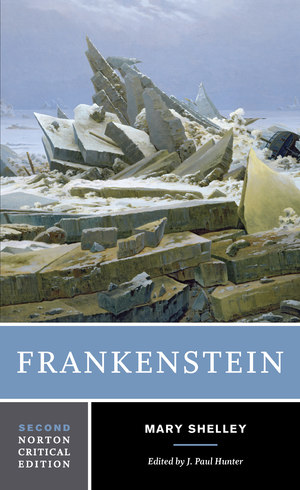
Frankenstein (1818): The Norton Critical Edition

Frankenstein, Second Edition
Norton Critical Editions
Mary Shelley (Author), J. Paul Hunter (Editor, University of Chicago)
http://books.wwnorton.com/books/webad.aspx?id=21895

Paperback
Book Details
Retail: $17.50
December 2011
ISBN: 978-0-393-92793-1
544 pages


Description:

The best-selling student edition on the market, now available in a Second Edition.

Almost two centuries after its publication, Frankenstein remains an indisputably classic text and Mary Shelley’s finest work.

This extensively revised Norton Critical Edition includes new texts and illustrative materials that convey the enduring global conversation about Frankenstein and its author. The text is that of the 1818 first edition, published in three volumes by Lackington, Hughes, Harding, Mavor, and Jones. It is accompanied by an expansive new preface, explanatory annotations, a map of Geneva and its environs, and seven illustrations, five of them new to the Second Edition.

Context is provided in three supporting sections: “Circumstance, Influence, Composition, Revision,” “Reception, Impact, Adaptation,” and “Sources, Influences, Analogues.” Among the Second Edition’s new inclusions are historical-cultural studies by Susan Tyler Hitchcock, William St. Clair, and Elizabeth Young; Chris Baldrick on the novel’s reception; and David Pirie on the novel’s many film adaptations. Related excerpts from the Bible and from John Milton’s Paradise Lost are now included, as is Charles Lamb’s poem “The Old Familiar Faces.”

“Criticism” collects sixteen major interpretations of Frankenstein, nine of them new to the Second Edition. The new contributors are Peter Brooks, Bette London, Garrett Stewart, James. A. W. Heffernan, Patrick Brantlinger, Jonathan Bate, Anne Mellor, Jane Goodall, and Christa Knellwolf.

A Chronology and Selected Bibliography are also included.


Contents

List of Illustrations

Introduction

The Text of Frankenstein

map: Geneva and Its Environs

Title page (1818)

Dedication (1818)

Preface

Frankenstein


Contexts

CIRCUMSTANCE, INFLUENCE, COMPOSITION, REVISION
  • Mary Shelley • Introduction to Frankenstein, Third Edition (1831)
  • John William Polidori • Letter Prefaced to The Vampyre (1819)
  • M. K. Joseph • The Composition of Frankenstein
  • Chris Baldick • [Assembling Frankenstein]
  • Richard Holmes • [Mary Shelley and the Power of Contemporary Science]
  • Christa Knellwolf and Jane Goodall • [The Significance of Place: Ingolstadt]
  • Charles E. Robinson • Texts in Search of an Editor: Reflections on The Frankenstein Notebooks and on Editorial Authority
  • Anne K. Mellor • Choosing a Text of Frankenstein to Teach

RECEPTION, IMPACT, ADAPTATION
  • Percy Bysshe Shelley • On Frankenstein
  • [John Croker] • From the Quarterly Review (January 1818)
  • Sir Walter Scott • From Blackwood’s Edinburgh Magazine (March 1818)
  • Edinburgh Magazine • [On Frankenstein] (March 1818)
  • Gentleman’s Magazine • [On Frankenstein] (April 1818)
  • Knight’s Quarterly • [On Frankenstein] (August–November 1824)
  • Hugh Reginald Haweis • Introduction to the Routledge World Library Edition (1886)
  • Chris Baldick • [The Reception of Frankenstein]
  • William St. Clair • [Frankenstein’s Impact]
  • Susan Tyler Hitchcock • [The Monster Lives On]
  • Elizabeth Young • [Frankenstein as Historical Metaphor]
  • David Pirie • Approaches to Frankenstein [in Film]

SOURCES, INFLUENCES, ANALOGUES
  • The Book of Genesis • [Biblical Account of Creation]
  • John Milton • From Paradise Lost
  • Percy Bysshe Shelley • Mont Blanc (1816)
  • [The Sea of Ice] (1817)
  • Mutability
  • George Gordon, Lord Byron • Prometheus
  • Darkness
  • From Childe Harold’s Pilgrimage, Canto III (1816)
  • Charles Lamb • The Old Familiar Faces 

Criticism

George Levine • Frankenstein and the Tradition of Realism

Ellen Moers • Female Gothic: The Monster’s Mother

Sandra M. Gilbert and Susan Gubar • Mary Shelley’s Monstrous Eve

Mary Poovey • “My Hideous Progeny”: The Lady and the Monster

Anne K. Mellor • Possessing Nature: The Female in Frankenstein

Peter Brooks • What Is a Monster? (According to Frankenstein)

Bette London • Mary Shelley, Frankenstein, and the Spectacle of Masculinity

Marilyn Butler • Frankenstein and Radical Science

Lawrence Lipking • Frankenstein, the True Story; or, Rousseau Judges Jean-Jacques

Garrett Stewart • In the Absence of Audience: Of Reading and Dread in Mary Shelley

James A. W. Heffernan • Looking at the Monster: Frankenstein and Film

Patrick Brantlinger • The Reading Monster

Jonathan Bate • [Frankenstein and the State of Nature]

Anne K. Mellor • Frankenstein, Racial Science, and the Yellow Peril

Jane Goodall • Electrical Romanticism

Christa Knellwolf • Geographic Boundaries and Inner Space: Frankenstein, Scientific Exploration, and the Quest for the Absolute


Mary Shelley: A Chronology

Selected Bibliography


Friedman and Kavey's Monstrous Progeny

Monstrous Progeny: A History of the Frankenstein Narratives
By Lester D. Friedman, Allison B. Kavey
https://www.rutgersuniversitypress.org/monstrous-progeny/9780813564234


256 pages, 37 photographs, 152.4 x 228.6

Paperback,August 1, 2016,$27.95
978-0-8135-6423-4

Cloth Over Boards,August 1, 2016,$90.00
978-0-8135-6424-1

PDF,August 1, 2016,$27.95
978-0-8135-6425-8

EPUB,August 1, 2016,$27.95
978-0-8135-7370-0


About This Book

Mary Shelley’s 1818 novel Frankenstein is its own type of monster mythos that will not die, a corpus whose parts keep getting harvested to animate new artistic creations. What makes this tale so adaptable and so resilient that, nearly 200 years later, it remains vitally relevant in a culture radically different from the one that spawned its birth?

Monstrous Progeny takes readers on a fascinating exploration of the Frankenstein family tree, tracing the literary and intellectual roots of Shelley’s novel from the sixteenth century and analyzing the evolution of the book’s figures and themes into modern productions that range from children’s cartoons to pornography. Along the way, media scholar Lester D. Friedman and historian Allison B. Kavey examine the adaptation and evolution of Victor Frankenstein and his monster across different genres and in different eras. In doing so, they demonstrate how Shelley’s tale and its characters continue to provide crucial reference points for current debates about bioethics, artificial intelligence, cyborg lifeforms, and the limits of scientific progress.

Blending an extensive historical overview with a detailed analysis of key texts, the authors reveal how the Frankenstein legacy arose from a series of fluid intellectual contexts and continues to pulsate through an extraordinary body of media products. Both thought-provoking and entertaining, Monstrous Progeny offers a lively look at an undying and significant cultural phenomenon.


Table of Contents

Acknowledgments

Introduction: Singing the Body Electric

1 In a Country of Eternal Light: Frankenstein’s Intellectual History

2 The Instruments of Life: Frankenstein’s Medical History

3 A More Horrid Contrast: From the Page to the Stage

4 It’s Still Alive: The Universal and Hammer Movie Cycles

5 The House of Frankenstein: Mary Shelley’s Step Children

6 Fifty Ways to Leave Your Monster

Notes

Select Bibliography

Index


About the Authors

LESTER D. FRIEDMAN is a professor and former chair of the Media and Society Program at Hobart and William Smith Colleges in Geneva, New York. He is the author, coauthor, or editor of over twenty books including American Cinema of the 1970s (Rutgers University Press) and the forthcoming, Tough Ain’t Enough.

ALLISON B. KAVEY is an associate professor of early modern history at CUNY John Jay College of Criminal Justice and the CUNY Graduate Center in New York, New York. She is the author, coauthor, or editor of several books including Second Star to the Right: Peter Pan in the Cultural Imagination, co-edited with Friedman (Rutgers University Press).


Sunday, August 13, 2017

Must Read: The Endurance of Frankenstein

The work that begin the discipline of Frankenstein Studies in 1979:

The Endurance of Frankenstein: Essays on Mary Shelley's Novel
George Levine (Editor), U. C. Knoepflmacher (Editor)
http://www.ucpress.edu/book.php?isbn=9780520046405

Available worldwide
Paperback, 362 pages
ISBN: 9780520046405
May 1982
$33.95, £27.95


Description:

MARY SHELLEY's Frankenstein; or, The Modern Prometheus grew out of a parlor game and a nightmare vision. The story of the book's origin is a famous one, first told in the introduction Mary Shelley wrote for the 1831 edition of the novel. The two Shelleys, Byron, Mary's stepsister Claire Clairmont, and John William Polidori (Byron's physician) spent a "wet, ungenial summer in the Swiss Alps." Byron suggested that "each write a ghost story." If one is to trust Mary Shelley's account (and James Rieger has shown the untrustworthiness of its chronology and particulars), only she and "poor Polidori" took the contest seriously. The two "illustrious poets," according to her, "annoyed by the platitude of prose, speedily relinquished their uncongenial task." Polidori, too, is made to seem careless, unable to handle his story of a "skull-headed lady." Though Mary Shelley is just as deprecating when she speaks of her own "tiresome unlucky ghost story," she also suggests that its sources went deeper. Her truant muse became active as soon as she fastened on the "idea" of "making only a transcript of the grim terrors of my waking dream": "'I have found it! What terrified me will terrify others."' The twelve essays in this collection attest to the endurance of Mary Shelley's "waking dream." Appropriately, though less romantically, this book also grew out of a playful conversation at a party. When several of the contributors to this book discovered that they were all closet aficionados of Mary Shelley's novel, they decided that a book might be written in which each contributor-contestant might try to account for the persistent hold that Frankenstein continues to exercise on the popular imagination. Within a few months, two films--Warhol's Frankenstein and Mel Brooks's Young Frankenstein--and the Hall-Landau and Isherwood-Bachardy television versions of the novel appeared to remind us of our blunted purpose. These manifestations were an auspicious sign and resulted in the book Endurance of Frankenstein.


Contents:

Detailed contents list from WorldCat (http://www.worldcat.org/title/endurance-of-frankenstein-essays-on-mary-shelleys-novel/oclc/5133230), the press's website only presents the major sections.

List of Illustrations

Preface

Mary Wollstonecraft Godwin Shelley and Frankenstein: A Chronology

[Part I. Traditions : looking forwards and backwards] Ambiguous heritage of Frankenstein / George Levine. Frankenstein as mystery play / Judith Wilt. Fire and ice in Frankenstein / Andrew Griffin --

[Part II. Biographical soundings : of mothers and daughters] Female Gothic / Ellen Moers. Thoughts on the aggression of daughters / U.C. Knoepflmacher --

[Part III. Contexts : society and self] Monsters in the garden : Mary Shelley and the bourgeois family / Kate Ellis. Mary Shelley's monster : politics and psyche in Frankenstein / Lee Sterrenburg. Vital artifice : Mary, Percy, and the psychopolitical integrity of Frankenstein / Peter Dale Scott --

[Part IV. Texture : language and the grotesque] "Godlike science / unhallowed arts" : language, nature and monstrosity / Peter Brooks. Frankenstein and comedy / Philip Stevick --

[Part V. Visual progeny : drama and film] Stage and film children of Frankenstein : a survey / Albert J. Lavalley. Coming to life : Frankenstein and the nature of film narrative / William Nestrick.

Appendix: "Face to face" : of man-apes, monsters, and readers.

Contributors
Selected Annotated Bibliography
Index

Tuesday, July 11, 2017

Fisch's Frankenstein: Icon of Modern Culture

The looks comparable to Hitchcock's book in term of offering a comprehensive history of the Frankenstein tradition, but the sections are broken into smaller units and (I think) it has more illustrations. Sadly, it appears out of print. 

Frankenstein: Icon of Modern Culture
http://www.helm-information.co.uk/frankenstein.htm
Audrey A. Fisch
Series: Icons of Modern Culture

Helm Information


Books details:

978-1-903206-20-1
320pp
55 illustrations
RRP £38
April 2009


Description:

This is the fifth book in the Icons of Modern Culture series. Children and adults the world over know the lumbering, overlarge figure with the green face and bolts in his head. How did the Halloween staple known as "Frankenstein" emerge out of the anonymous novel by a "young girl," published in 1818 to mixed reviews? The answer, as this study makes clear, is that the "Frankenstein" we know today is not solely Mary Shelley’s progeny. "Frankenstein" morphed into many different forms over time, place, and genre. This volume displays and analyses the many post-Shelley "Frankensteins," exploring their continuities and disjunctions in order to trace the development of this enduring icon. The volume also traces the complex history of Mary Shelley’s Frankenstein, including its publishing history, its dismissal by the literary establishment, and its subsequent reclamation as a touchstone text in high school and college classrooms. Students of Shelley’s novel or of the many "Frankensteins" her novel propagated will find here an analysis of this intriguing cultural history. This volume also provides extensive extracts, gathering together an unprecedented collection of both never-before published and previously published material, so that readers can read widely and develop their own sense of "Frankenstein’s" place in our world.


Table of Contents:


List of Illustrations

Acknowledgements

Series Editor’s Preface


Introduction


Section 1 – Mary Shelley and the first "Frankensteins"

1. Publication

2. Frankenstein, Godwin, and Wollstonecraft

3. Reception

4. Early Science

5. The Nature of Man

6. Percy Shelley and Frankenstein

7. Mary Shelley and Frankenstein

8. Revision and Authorship


Section 2 – Beyond Mary Shelley

9. Early Theatre 1823–1826

10. Victorian Burlesque-Extravaganza

11. Other Victorian "Frankensteins"

12. Silent Film

13. Early Twentieth-Century Drama

14. Whale, Hammer, and Beyond

15. Feminist Canonisation

16. Critical Progeny

17. The Scientific Legacy of "Frankenstein"

18. Contemporary "Frankenstein"


Conclusion: Ubiquitous "Frankenstein"


Appendix: "The Death Bride" from Tales of the Dead


Bibliography


Index


About the author:

Audrey A. Fisch is Professor of English and Coordinator of Secondary English Education at New Jersey City University. She is the editor of The Other Mary Shelley: Beyond Frankenstein and The Cambridge Companion to the African American Slave Narrative and the author of American Slaves in Victorian England: Abolitionist Politics in Popular Literature and Culture.

Must Read: Hitchcock's Frankenstein: A Cultural History

A masterful survey of the Frankenstein tradition:

Frankenstein:A Cultural History
By Susan Tyler Hitchcock
W. W. Norton
http://books.wwnorton.com/books/978-0-393-06144-4/

Book Details
Hardcover
October 2007
ISBN 978-0-393-06144-4
5.9 × 8.5 in / 400 pages

Sales Territory: Worldwide including Canada, but excluding the British Commonwealth.


Overview

A lively history of the Frankenstein myth, tracing its evolution from a Romantic nightmare to its prominence in today's imaginative landscape.

Frankenstein began as the nightmare of an unwed teenage mother in Geneva, Switzerland, in 1816. At a time when the moral universe was shifting and advances in scientific knowledge promised humans dominion over that which had been God's alone, Mary Shelley envisioned a story of human presumption and its misbegotten consequences. Two centuries later, that story is still constantly retold and reinterpreted, from Halloween cartoons to ominous allusions in the public debate, capturing and conveying meaning central to our consciousness today and our concerns for tomorrow. From Victorian musical theater to Boris Karloff with neck bolts, to invocations at the President's Council on Bioethics, the monster and his myth have inspired everyone from cultural critics to comic book addicts. This is a lively and eclectic cultural history, illuminated with dozens of pictures and illustrations, and told with skill and humor. Susan Tyler Hitchcock uses film, literature, history, science, and even punk music to help us understand the meaning of this monster made by man.


Contents (from WorldCat)

Conception --
Birth and lineage --
Reception and revision --
The monster lives on --
Making more monsters --
A monster for modern times --
A brave new world of monsters --
The horror and the humor --
Monsters in the living room --
Taking the monster seriously --
The monster and his myth today.


Monday, July 10, 2017

Klinger's The New Annotated Frankenstein due August 2017

The New Annotated Frankenstein
http://books.wwnorton.com/books/978-0-87140-949-2/

Mary Shelley (Author), Leslie S. Klinger (Editor)

With an Introduction by Guillermo del Toro, With an Afterword by Anne K. Mellor

A Liveright book

Book Details

Retail Price: $35.00
Hardcover
Forthcoming August 2017
ISBN 978-0-87140-949-2
8.9 × 10.3 in / 432 pages
Sales Territory: Worldwide


Two centuries after its original publication, Mary Shelley’s classic tale of gothic horror comes to vivid life in "what may very well be the best presentation of the novel" to date (Guillermo del Toro).

"Remarkably, a nineteen-year-old, writing her first novel, penned a tale that combines tragedy, morality, social commentary, and a thoughtful examination of the very nature of knowledge," writes best-selling author Leslie S. Klinger in his foreword to The New Annotated Frankenstein. Despite its undeniable status as one of the most influential works of fiction ever written, Mary Shelley’s novel is often reductively dismissed as the wellspring for tacky monster films or as a cautionary tale about experimental science gone haywire. Now, two centuries after the first publication of Frankenstein, Klinger revives Shelley’s gothic masterpiece by reproducing her original text with the most lavishly illustrated and comprehensively annotated edition to date.

Featuring over 200 illustrations and nearly 1,000 annotations, this sumptuous volume recaptures Shelley’s early nineteenth-century world with historical precision and imaginative breadth, tracing the social and political roots of the author’s revolutionary brand of Romanticism. Braiding together decades of scholarship with his own keen insights, Klinger recounts Frankenstein’s indelible contributions to the realms of science fiction, feminist theory, and modern intellectual history—not to mention film history and popular culture. The result of Klinger’s exhaustive research is a multifaceted portrait of one of Western literature’s most divinely gifted prodigies, a young novelist who defied her era’s restrictions on female ambitions by independently supporting herself and her children as a writer and editor.

Born in a world of men in the midst of a political and an emerging industrial revolution, Shelley crafted a horror story that, beyond its incisive commentary on her own milieu, is widely recognized as the first work of science fiction. The daughter of a pioneering feminist and an Enlightenment philosopher, Shelley lived and wrote at the center of British Romanticism, the “exuberant, young movement” that rebelled against tradition and reason and "with a rebellious scream gave birth to a world of gods and monsters" (del Toro).

Following his best-selling The New Annotated H. P. Lovecraft and The New Annotated Sherlock Holmes, Klinger not only considers Shelley’s original 1818 text but, for the first time in any annotated volume, traces the effects of her significant revisions in the 1823 and 1831 editions. With an afterword by renowned literary scholar Anne K. Mellor, The New Annotated Frankenstein celebrates the prescient genius and undying legacy of the world’s "first truly modern myth."

The New Annotated Frankenstein includes:
  • Nearly 1,000 notes that provide information and historical context on every aspect of Frankenstein and of Mary Shelley’s life
  • Over 200 illustrations, including original artwork from the 1831 edition and dozens of photographs of real-world locations that appear in the novel
  • Extensive listings of films and theatrical adaptations
  • An introduction by Guillermo del Toro and an afterword by Anne K. Mellor