Celebrating in 2026: the 105th anniversary of the lost film Il Mostro di Frankenstein (1921); the 95th anniversary of Universal Studios’ Frankenstein (1931); the 60th anniversary of Dell Comics’ superhero version of Frankenstein (1966), Hanna Barbera’s television hero Frankenstein Jr, co-star of the series Frankenstein Jr. and The Impossibles (1966), and the films Jesse James Meets Frankenstein's Daughter (1966) and The War of the Gargantuas (1966); the 55th anniversary of General Mills’ cereal mascot Franken Berry (1971); the 50th anniversary of the Saturday-morning television series Monster Squad (1976); the 45th anniversary of the anime film Kyofu Densetsu: Kaiki! Furankenshutain (1981); the 40th anniversary of Ken Russell’s film Gothic (1986) and Fred Saberhagen’s novel The Frankenstein Papers (1986); the 25th anniversary of Curtis Jobling’s picture book Frankenstein's Cat (2001); the 20th anniversary of Grant Morrision’s comic book series Seven Soldiers: Frankenstein (2006); the 15th anniversary of Nick Dear’s play Frankenstein (2011); the 10th anniversary of the Royal Ballet's production of Frankenstein (2016); and the release of Maggie Gyllenhaal’s film Bride! (2026).
Showing posts with label Frankenstein Tradition. Show all posts

Wednesday, March 4, 2026

New Book - Remaking the Monster: Transmedia Adaptations of Frankenstein’s Creature

Remaking the Monster: Transmedia Adaptations of Frankenstein’s Creature

Alissa Burger (Author)


Full details and ordering information at https://www.bloomsbury.com/us/remaking-the-monster-9781666970258/.


Description

In Remaking the Monster, Alissa Burger adopts an interdisciplinary approach to examine the continued influence of Frankenstein's Creature on popular culture, demonstrating through close readings the necessity of reconsidering its role and meaning as it has changed over time.

Since the Creature's introduction to the horror genre's canon, proliferating and evolving for over a century across a variety of media formats and genres, Burger posits that each new iteration of its appearance and impact encourages audiences to (re)consider critical questions about society and about ourselves. What are we capable of-both good and bad? What care, if any, do we owe to one another? And how might a monstrous appearance belie a deeper truth?

Ultimately, Burger argues, wherever and however the Creature appears, part of its innate function-and perhaps, the key to its perennial resonance with audiences-is found in the approachable opportunity to engage with daunting concepts of life and death, choice, agency, and, above all, what it means to be human.


Table of Contents

Introduction

PART I: THEMES

1. Boris Karloff as the Creature

2. Encountering the Creature

3. A Community of Monsters

4. Gothic Prestige

5. The Desirable Creature


PART II: FORMATS

6. New Visions of the Creature in Graphic Narratives

7. The Animated Creature

8. Board Games

9. Video Games

10. Creating the Creature

Conclusion


About the Author

Index


Product details

Published Feb 05 2026

Format Hardback

Edition 1st

Extent 240

ISBN 9781666970258

Imprint Bloomsbury Academic

Dimensions 9 x 6 inches

Series Villains and Creatures: Critical Perspectives on Cultural Tropes

Publisher Bloomsbury Publishing


About the Author

Biography

Alissa Burger is Associate Professor of English at Culver-Stockton College, USA. She teaches courses in research, writing, and literature, specializing in gender, horror, and the Gothic. She is the author of IT, Chapters One & Two (2023), The Quest for the Dark Tower: Genre and Interconnection in the Stephen King Series (2021), Teaching Stephen King: Horror, The Supernatural, and New Approaches to Literature (2016) and The Wizard of Oz as American Myth: A Critical Study of Six Versions of the Story, 1900-2007 (2012).


Recent from Applause - Blazing Saddles Meets Young Frankenstein

Blazing Saddles Meets Young Frankenstein: The 50th Anniversary of the Year of Mel Brooks

Bruce G. Hallenbeck (Author)

Full details and ordering information at https://www.bloomsbury.com/us/blazing-saddles-meets-young-frankenstein-9781493078004/


Description

An in-depth look at the 1974 releases of Mel Brooks's Blazing Saddles and Young Frankenstein that will leave cinephiles enthralled.

1974 was a busy year for Mel Brooks. Although still recovering after a series of failed projects threatened his career, he pulled off a one-two punch that saw the release of two of the most beloved American comedies ever made: Blazing Saddles and Young Frankenstein. Although both films are well-known, the stories beyond the making of each movie are less so. How did they come to be, and how did the era’s culture and politics not only permit them to be made, but help them to become enduring comedy classics?

With their riotous parodies of Westerns and classic horror movies, Blazing Saddles and Young Frankenstein were not only hilarious. They played with charged social and cultural themes in an inimitable way, raising the bar for modern comedies even as they reshaped the two genres they were sending up. Blazing Saddles Meets Young Frankenstein: The 50th Anniversary of the Year of Mel Brooks explores in depth the zeitgeist and cinematic alchemy that led to 1974 becoming “the year of Mel Brooks.”


Product details

Published Nov 12 2024

Format Paperback

Edition 1st

Extent 272

ISBN 9781493078004

Imprint Applause

Illustrations 25 Color Photos

Dimensions 0 x 0 inches

Publisher Bloomsbury Publishing


About the Author

Bruce G. Hallenbeck is an author, actor, and screenwriter whose films include Vampyre, Fangs, and The Drowned. His many books on film history include The Hammer Frankenstein, Rock’n’Roll Monsters: The American International Story, and Poe Pictures. Hallenbeck has also acted in such features as Shadow Tracker, Edge of Reality, and Project D: Classified. He lives in upstate New York with his wife Rosa, two cats, and several ghosts.

Sunday, August 27, 2023

Out Now - New Edition of The Frankenstein Legend


First published in 1973, The Frankenstein Legend: A Tribute to Mary Shelley and Boris Karloff, written by Donald F. Glut, has recently been re-issued in a second edition (published by Strange Particle Press in 2022). The work covers Shelley's novel and its adaptation on stage and screen (both film and television), for radio, in fiction, and as comics. 

Comprising over 400 pages, much of the content is repeated from the original edition, but Glur has included new and/or updated images to accompany the text. In addition, Glut adds a new illustrated afterword that provides updates to various sections of the text. 


I couldn't find a direct link for Strange Particle Press, but the book can be purchased from various online booksellers as print-on-demand and electronic versions. 


Tuesday, August 8, 2023

CFP They Live: Female Monsters and Their Impact on the Frankenstein Tradition (9/30/2023; NeMLA Boston 3/7-10/2024)

They Live: Female Monsters and Their Impact on the Frankenstein Tradition


Sponsored by the Monsters & the Monstrous Area of the Northeast Popular Culture Association

Organized by Michael A. Torregrossa


Call for Papers - Please Submit Proposals by 30 September 2023

55th Annual Convention of Northeast Modern Language Association

Sheraton Boston Hotel (Boston, MA)

On-site event: 7-10 March 2024


See the shared Google Doc for the full call with a list of bibliographic resources on the topic: https://tinyurl.com/They-Live-NeMLA-2024.


Session Information


In this session, we seek to engage with and to build upon the work of Erin Hawley in “The Bride and Her Afterlife: Female Frankenstein Monsters on Page and Screen” in order to develop a more complete picture of the roles of the Bride of Frankenstein and her analogues within the Frankenstein tradition.


In 2025, James Whale’s film Bride of Frankenstein will celebrate its 90th anniversary. This is an important milestone, but it has a larger impact beyond the world of film. In both Frankenstein (1931) and Bride of Frankenstein, Whale and make-up artist Jack Pierce gave life to two iconic figures of modern popular culture: the Monster (played by Boris Karloff) and the Bride (played by Elsa Lanchester).


The creation of the Bride was especially significant since in the source, Mary Shelley’s Frankenstein, the mate of the creature is destroyed while still in progress. There is no meeting of Victor Frankenstein’s creations. In the film, however, the Bride is completed, brought to life, and briefly interacts with her intended. Unfortunately, the pair fail to connect, and, by the film’s end, the Bride is destroyed again.


Despite this, once having encountered her in the flesh through Lanchester’s portrayal, it was impossible for creative artists to let the Bride stay dead. For at least six of her almost nine decades, the Bride of Frankenstein has been revived time and again in a diverse variety of media, including artwork, cartoons, children’s books, comics, films, games, prose fiction, and television programs. Each new text offers an innovative contribution to the ongoing Frankenstein tradition through the ways the Bride and her analogues forge new narratives as they act with and react to other characters within the base story.


Submissions might explore


  • The ways the Bride of Frankenstein and her analogues transform the story through their roles as wives and mothers as they bring to fulfillment many of the hopes expressed by the creature in Shelley’s novel
  • The ways versions of female Frankensteins that take a darker turn bring about the bleaker visions Victor Frankenstein has for his creation(s)
  • How the existence of female Frankensteins (even when absent) reshapes many of their male counterparts by moving them from menaces to husbands and fathers


See the shared Google Doc for the full call with a list of bibliographic resources on the topic: https://tinyurl.com/They-Live-NeMLA-2024. Further resources about the Frankenstein tradition can be found at our website Frankenstein and the Fantastic at https://frankensteinandthefantastic.blogspot.com/. Do connect with any ideas for additional references and/or resources.


Thank you for your interest in our session. Please address questions and/or concerns to the organizers at popular.preternaturaliana@gmail.com.


For more information on the Monsters & the Monstrous Area of the Northeast Popular Culture Association, please visit our website at https://popularpreternaturaliana.blogspot.com/.


Submission Information


All proposals must be submitted into the CFPList system at https://cfplist.com/nemla/Home/S/20362 by 30 September 2023. You will be prompted to create an account with NeMLA (if you do not already have one) and, then, to complete sections on Title, Abstract, and Media Needs.


Notification on the fate of your submission will be made prior to 16 October 2023. If favorable, please confirm your participation with chairs by accepting their invitations and by registering for the event. The deadline for Registration/Membership is 9 December 2023.


Be advised of the following policies of the Convention: All participants must be members of NeMLA for the year of the conference. Participants may present on up to two sessions of different types (panels/seminars are considered of the same type). Submitters to the CFP site cannot upload the same abstract twice.(See the NeMLA Presenter Policies page, at https://www.buffalo.edu/nemla/convention/policies.html, for further details,)


Thank you for your interest in our session. Please address questions and/or concerns to the organizers at popular.preternaturaliana@gmail.com.


Sunday, June 19, 2022

Frankenstein in Comics New Scholarship

Apologies for tooting my own horn, but I recently had three items published based on my ongoing work on adaptations of Frankenstein the comics.

The citations are as follows:


Torregrossa, Michael A. “Building a Better Bride: Female Frankenstein Monsters in the Comics.” Proceedings of the 2020 Science Fictions Popular Cultures Academic Conference, edited by Timothy F. Slater, Carrie J. Cole, and Greg Littman, Pono Publishing, 2020, pp. 165-73. ISBN 979-8689344874 (paperback); eBook ASIN B08NT97MFD. 

Torregrossa, Michael A. “Frankenstein and Its Legacy in the Comics.” International Journal of Comic Art, vol. 23, no. 2, Fall/Winter 2021, pp. 432-40.

Torregrossa, Michael. “She Lives: Bringing the Bride of Frankenstein to Life in the Comics.” Proceedings of the 33rd Annual Far West Popular Culture Association Conference, edited by David G. Schwartz, Digital Scholarship@UNLV, 2021, digitalscholarship.unlv.edu/fwpca/33rdannual/fourtwo/3/.


Saturday, October 12, 2019

Recent Book: Transmedia Creatures: Frankenstein’s Afterlives

I believe this was the last collection of essays that came out in print for the 200th-anniversary of Frankenstein. My apologies for the delay in posting the details.


Transmedia Creatures: Frankenstein’s Afterlives
Edited by Francesca Saggini, Anna Enrichetta Soccio.
https://www.rutgersuniversitypress.org/transmedia-creatures/9781684480616


Contributions by Lidia De Michelis, Eleanor Beal, Gino Roncaglia, Claire Nally, Claudia Gualtieri, Federico Meschini, Enrico Reggiani, Diego Saglia, Daniele Pio Buenza, Ruth Heholt, Andrew McInnes, Janet Larson

296 pages, 6, 6 x 9

Paperback,October 19, 2018,$29.95
978-1-6844-8060-9
[other formats also available]


About This Book
On the 200th anniversary of the first edition of Mary Shelley’s Frankenstein, Transmedia Creatures presents studies of Frankenstein by international scholars from converging disciplines such as humanities, musicology, film studies, television studies, English and digital humanities. These innovative contributions investigate the afterlives of a novel taught in a disparate array of courses - Frankenstein disturbs and transcends boundaries, be they political, ethical, theological, aesthetic, and not least of media, ensuring its vibrant presence in contemporary popular culture. Transmedia Creatures highlights how cultural content is redistributed through multiple media, forms and modes of production (including user-generated ones from “below”) that often appear synchronously and dismantle and renew established readings of the text, while at the same time incorporating and revitalizing aspects that have always been central to it. The authors engage with concepts, value systems and aesthetic-moral categories—among them the family, horror, monstrosity, diversity, education, risk, technology, the body—from a variety of contemporary approaches and highly original perspectives, which yields new connections. Ultimately, Frankenstein, as evidenced by this collection, is paradoxically enriched by the heteroglossia of preconceptions, misreadings, and overreadings that attend it, and that reveal the complex interweaving of perceptions and responses it generates.

Published by Bucknell University Press. Distributed worldwide by Rutgers University Press.


Table of Contents

Abbreviations ix

Introduction: Frankenstein: Presence, Process, Progress
Francesca Saggini

PA R T I
Labs, Bots, and Punks: Transmediating Technology and Science
1 Frankenstein and Science Fiction
Gino Roncaglia
2 Monstrous Algorithms and the Web of Fear: Risk, Crisis, and Spectral Finance in Robert Harris’s The Fear Index
Lidia De Michelis
3 Frankensteinian Gods, Fembots, and the New Technological Frontier in Alex Garland’s Ex_Machina
Eleanor Beal

PA R T I I
Becoming Monsters: The Limits of the Human
4 Staging Steampunk Aesthetics in Frankenstein Adaptations: Mechanization, Disability, and the Body
Claire Nally
5 Frankenstein; or, the Modern Prometheus in the Postcolony
Claudia Gualtieri
6 Four- Color Myth: Frankenstein in the Comics
Federico Meschini

PA RT I I I
The Evolution Games of Sight and Sound
7 “Uncouth and inarticulate sounds”: Musico- Literary Traces in Frankenstein, and Frankenstein in Art Music
Enrico Reggiani
8 Enter Monsieur le Monstre: Cultural Border- Crossing and Frankenstein in London and Paris in 1826
Diego Saglia
9 The Theme of the Doppelgänger in James Searle Dawley’s Frankenstein
Daniele Pio Buenza
10 Perverting the Family: Re- Working Victor Frankenstein’s Gothic Blood- Ties in Penny Dreadful
Ruth Heholt

PA R T I V
Monster Reflections
11 The Masked Performer and “the Mane Electric”: The Lives and Multimedia Afterlives of Margaret Atwood’s Doctor Frankenstein
Janet Larson
12 Young Adult Frankenstein
Andrew McInnes
13 Revivifying Frankenstein’s Myth: Historical Encounters and Dialogism in Back from the Dead:
The True Sequel to Frankenstein
Anna Enrichetta Soccio

Acknowledgments

Bibliography

Index

About the Contributors


About the Author/Editor
FRANCESCA SAGGINI is a professor of English literature at the Università della Tuscia in Viterbo, Italy. She is the author of many books, including The Gothic Novel and the Stage: Romantic Appropriations.

ANNA E. SOCCIO is a professor of English literature at the Università G. d’Annunzio in Chieti, Italy. She is the author of several books, including Come leggere “Hard Times”.


CFP Frankenstein’s Lives: Shelley’s Novel as Cultural Phenomenon (expired)

Profuse apologies for having missed this as well.


Frankenstein’s Lives: Shelley’s Novel as Cultural Phenomenon
https://call-for-papers.sas.upenn.edu/cfp/2019/02/21/frankenstein%E2%80%99s-lives-shelley%E2%80%99s-novel-as-cultural-phenomenon

deadline for submissions: May 20, 2019

full name / name of organization:
Robert I. Lublin and Elizabeth Fay

contact email:
robert.lublin@umb.edu

Call for Papers: Frankenstein’s Lives: Shelley’s Novel as Cultural Phenomenon

Co-edited by Robert I. Lublin and Elizabeth Fay

We seek chapter proposals for a collection that celebrates the 200th anniversary of the publication of Mary Shelley’s Frankenstein.

After 200 years, Frankenstein has emerged into an international cultural phenomenon. During the novel’s bicentennial, events took place around the world to celebrate the novel’s publication. Frankenstein continues to be more salient than ever. We are compiling a collection that explores the range of cultural responses the novel has elicited as well as the ways it continues to be relevant to our world today and to the future.

Frankenstein’s Lives will explore the various ways that the novel has proved to be a cultural touchstone, particularly in moments of stress. For instance, The Living Theatre creatively responded to the politics of the 1960s with their piece of “total theatre,” Frankenstein. Today, more than ever, the novel speaks to us as we encounter an increasingly uncertain world. Recent theatrical revisions have staged the novel in politically trenchant ways. 21st century film versions highlight 21st century fears. The novel also speaks to current political pressures that threaten to tear our world apart. Essays may take a broad range of approaches, so long as they seek to make sense of the cultural phenomenon Frankenstein has become. We welcome critical and creative interventions in our understanding of the novel as a social and cultural phenomenon.


Possible chapter topics:


  • Science Fiction
  • Frankenstein on stage
  • Gender studies
  • Technology
  • Animal studies
  • Food
  • Artistic responses
  • Music
  • Postcolonialism
  • Poststructural philosophy
  • Politics
  • Monstrosity


Please submit a proposal (500 word max) along with a brief bio (50 word max) to both Robert I. Lublin (robert.lublin@umb.edu) and Elizabeth Fay (elizabeth.fay@umb.edu) by May 20, 2019. Final essays should be 6500-9000 words, including notes and citations. Feel free to contact the co-editors if you have any questions.


Last updated February 21, 2019
This CFP has been viewed 2,920 times.


Saturday, June 23, 2018

CFP Frankenstein: Two Hundred Years of Monsters Conference (expired)

Came across this by accident today; sadly, it is also expired.

Frankenstein: Two Hundred Years of Monsters
http://hrc.cass.anu.edu.au/events/frankenstein-two-hundred-years-monsters


- Call for Papers -

Frankenstein 2018: Two Hundred Years of Monsters

12 ‐ 15 September 2018
The Australian National University and the National Film and Sound Archive, Canberra


Nearly two centuries after its anonymous publication on 1 January 1818, Mary Shelley’s Frankenstein or, The Modern Prometheus remains as topical as ever. Its core story - of a recklessly ambitious and naïve scientist whose artificial, human-like creature arouses only horror and disgust, and escapes control to seek revenge on his creator - has become, for better or worse, the techno‐scientific fable of modernity. First adapted for stage by Richard Brinsley Peake in 1823, and for film by Edison Studios in 1910, the story has inspired more theatre, film, television and other adaptations than any other modern narrative, with more than 50 screen adaptations appearing in the 2010s alone. From Fritz Lang’s Metropolis to Alex Garland’s Ex Machina, and The Rocky Horror Picture Show to The Addams Family, the Frankenstein myth reaches into every recess of high and popular culture.

We invite proposals for 20-­minute papers or 3 x 20‐minute panel sessions from scholars across the humanities, sciences, and social sciences that respond in interdisciplinary ways to this most interdisciplinary of novels, including, but not limited to:

  • Literary studies, especially of the long eighteenth century, Romanticism, Victorian and neo­‐Victorian literature
  • Re-tellings and re-­‐imaginings of the Frankenstein story in various modes and genres, e.g. SF, steampunk, speculative fiction, slash fiction, etc.
  • Film, television, theatre and performance, and visual studies
  • Digital humanities, reception studies, histories of popular culture, and media ecologies
  • Gender studies, queer theory, and the history of sexuality
  • Disability studies and post‐humanism
  • The history of medicine, especially reproductive technologies
  • Science and technology studies; images and imaginaries of science and scientists
  • The history and philosophy of biology, especially in relation to vitalism
  • Eco‐criticism and the Anthropocene
  • Affect theory and the history of emotions
  • Frankenstein and race, colonialism, empire
  • Global and local Frankensteins, e.g. Australian Frankensteins
  • Frankenstein and material history
  • Cyborgs, robots, artificial intelligence, and machine learning
  • Synthetic biology, genetic engineering, and artificial life

To maintain order among this menagerie of monsters, we propose the following four overarching themes, each of which will be addressed by one of our keynote speakers:

Frankenstein in 1818: historicising the monster
(Professor Sharon Ruston, Lancaster)

Frankenstein as scientific fable: from grave-­‐robbing and galvanism to synthetic biology and machine learning
(Professor Genevieve Bell, Australian National University)

Adaptation and experimentation: Frankenstein in film and other media
(Assistant Professor Shane Denson, Stanford)

Frankenstein’s queer family: gender, sexuality, reproduction and the work of care
(Professor Julie Carlson, University of California, Santa Barbara)


Please send proposals for papers or sessions - including a title, 250­‐word abstract, and brief author biography - to Dr Russell Smith at russell.smith@anu.edu.au.

The deadline for proposals is 6 April 2018. Proposals will be reviewed by a committee comprising scholars from the humanities, sciences, and social sciences, and applicants will be informed of the outcome within two weeks of the submission deadline. Please note that we will endeavour to notify overseas applicants earlier if they submit proposals before the submission deadline.

For further information and updates, as well as information about the Humanities Research Centre’s annual theme for 2018, Imagining Science and Technology 200 Years after Frankenstein, see here.

Please direct any inquiries to Penny Brew at hrc@anu.edu.au.


CFP Of 'Gods and Monsters': Shelley's Frankenstein Two Hundred Years On (expired)

Not sure how I missed posting this sooner:

Of 'Gods and Monsters': Shelley's Frankenstein Two Hundred Years On
https://call-for-papers.sas.upenn.edu/cfp/2017/10/24/of-gods-and-monsters-shelleys-frankenstein-two-hundred-years-on

deadline for submissions: January 15, 2018

full name / name of organization: Roger Stanley/Southeast Regional Conference on Christianity and Literature

contact email: rstanley@uu.edu


Of ‘Gods and Monsters’: Shelley’s Frankenstein Two Hundred Years On

Southeast Conference on Christianity and Literature

19-21 April 2018

Union University

Jackson, Tennessee


Keynote Speaker:

Dr. Christina Bieber Lake, Clyde S. Kilby Professor of English, Wheaton College

Prophets of the Posthuman: American Literature, Biotechnology and the Ethics ofPersonhood

(Univ. of Notre Dame Press, 2013)

Dr. Bieber Lake is also the author of the book The Incarnational Art of Flannery O’Connor and many articles which have appeared in Books & Culture and elsewhere.


The primary theme of the convention will be a celebration of the bicentennial of the publication of Mary Shelley’s Frankenstein. Union University itself envisions a campus-wide, interdisciplinary commemoration for the calendar year, though the focus for this conference will be, as always, on the intersection of theology and fiction.

Within the Frankenstein motif, possible topics and areas of interest include:

--Mary Shelley’s legacy in contemporary science fiction

---Creation: Human, subhuman and posthuman

--Narrative frames and the voice of the marginalized

--Science, technology, and the limitations of knowledge

--Maternity and paternity

--Idealized vs. “monstrous” femininity

--“Singularity” in terms of AI vs. human intelligence

--Revisions of Frankenstein in movies/pop culture


As always, SECCL is open to other proposals concerning the relationship of Christianity and literature. Abstracts from graduate students are also welcome. Undergraduates should send complete papers.

Send abstracts (400-500) words via email attachment to Prof. Roger Stanley, at rstanley@uu.edu . The submission deadline is January 15, 2018.

CFP The Silent Revolution Conference (6/30/2018; Lisbon 11/5-6/2018)


1818-2018 – the silent revolution: of fears, folly & the female
https://call-for-papers.sas.upenn.edu/cfp/2018/06/22/1818-2018-%E2%80%93-the-silent-revolution-of-fears-folly-the-female

deadline for submissions: June 30, 2018

full name / name of organization: Universidade Catolica Portuguesa

contact email: cecc@fch.lisboa.ucp.pt


1818-2018 – the silent revolution: of fears, folly & the female

Universidade Católica Portuguesa, Lisbon

5-6 November 2018


In 2018 we celebrate events which took place two hundred years ago: the publication of Mary Shelley’s Frankenstein and the birth of Emily Brontë. While the two events are markedly different, as the former is a tangible work of art and the latter more of a promise of what was to come, both have contributed to challenge and change the conceptions and perceptions of the time, thus performing a silent, subtle revolution in the world of letters.


Shelley and Brontë are mostly famous for one novel each, but these novels have helped shape Western imagination and literature, as they arguably ‘disclose uncommon powers of poetic imagination’, as Walter Scott said a propos Shelley’s oeuvre [Blackwood's Edinburgh Magazine 2 (March 1818)].


By focusing on characters who do not belong anywhere – ‘I am an unfortunate and deserted creature; I look around, and I have no relation or friend upon earth’ (Shelley, 2004: 160) and ‘Not a soul knew to whom it [Heathcliff] belonged’ (Brontë, 1965: 78) –, both novels seem to question the hegemonic discourse of the time. As such, their global appeal may precisely reside in their radical difference and ‘unbelonging’ (Rushdie, 2013), which, paradoxically, make them potential sites for multiple identifications – the female, the savage, the foreigner.


This conference brings the two female authors together, for their Å“uvres, as different as they are, may shed light on a topic that resonates nowadays – how gender impacts on authorship, imagination, and a sense of humanity. If, as Woolf claims, ‘women have served all these centuries as looking-glasses possessing the magic and delicious power of reflecting the figure of man as twice its natural size’ (Woolf, 2000: 45), is it entirely possible that women authors have resorted to the misshapen, dark, monstrous Other as alter egos of their own perception of themselves and their place in society?


The conference wishes to be a locus of celebration and discussion, both by placing the authors in the context of their time (coeval artists and ideas), and by displacing them and investigating their impact on literature and other media (music, cinema, videogames, etc.). By rereading the works critically in the context of a 200-hundred-year time lapse, the conference aims to look at the texts as clues ‘to how we live, how we have been living, how we have been led to imagine ourselves, how our language has trapped as well as liberated us, how the very act of naming has been till now a male prerogative, and how we can begin to see and name – and therefore live – afresh’ (Rich, 1979: 35).


Papers on the following topics are welcome:

  • Male privilege in literature: revising concepts of authority and authorship
  • Female gaze and the imagination
  • 19th-century language, gender and cultural filters
  • Concepts of human being, humanity, humanness and ‘technogenesis’
  • Displacement and replacement as male anxieties
  • 1st-person narration: giving voice and / or visibility to ghosts, monsters and waifs
  • The impact of Shelly and Brontë in English-speaking and world literature
  • Pseudonymity and power
  • The monster within: representations of (female) fear and folly in literature
  • ‘Savagery’ at the heart of Europe and the ideal of la mission civilisatrice
  • Siting contestation: literature on progress and knowledge
  • Is Gothic literature female?
  • Translating ‘strangeness’ into different languages and / or media
  • The afterlife of Frankenstein and Wuthering Heights in art and pop culture
  • Fandom and the Gothic experience


Keynote speakers:

Luísa Leal Faria (Universidade Católica Portuguesa)

Marie Mulvey-Roberts (University of the West of England – Bristol)


Click below for further information.


Tuesday, June 12, 2018

Frankenstein and Its Classics

Due out this summer:
Frankenstein and Its Classics: The Modern Prometheus from Antiquity to Science Fiction
https://www.bloomsbury.com/us/frankenstein-and-its-classics-9781350054875/
Editor(s): Benjamin Eldon Stevens, Jesse Weiner, Brett M. Rogers

Published: 08-09-2018
Format: Paperback
Edition: 1st
Extent: 288
ISBN: 9781350054875
Imprint: Bloomsbury Academic
Series: Bloomsbury Studies in Classical Reception
Illustrations: 14 bw illus
Dimensions: 6 1/8" x 9 1/4"
List price: $29.95

Also available in hardcover and ebook formats.


About Frankenstein and Its Classics

Frankenstein and Its Classics is the first collection of scholarship dedicated to how Frankenstein and works inspired by it draw on ancient Greek and Roman literature, history, philosophy, and myth. Presenting twelve new essays intended for students, scholars, and other readers of Mary Shelley's novel, the volume explores classical receptions in some of Frankenstein's most important scenes, sources, and adaptations. Not limited to literature, the chapters discuss a wide range of modern materials-including recent films like Alex Garland's Ex Machina and comics like Matt Fraction's and Christian Ward's Ody-C-in relation to ancient works including Hesiod's Theogony, Aeschylus's Prometheus Bound, Ovid's Metamorphoses, and Apuleius's The Golden Ass.

All together, these studies show how Frankenstein, a foundational work of science fiction, brings ancient thought to bear on some of today's most pressing issues, from bioengineering and the creation of artificial intelligence to the struggles of marginalized communities and political revolution. This addition to the comparative study of classics and science fiction reveals deep similarities between ancient and modern ways of imagining the world-and emphasizes the prescience and ongoing importance of Mary Shelley's immortal novel. As Frankenstein turns 200, its complex engagement with classical traditions is more significant than ever.


Table of contents

Introduction: The Modern Prometheus Turns 200
Jesse Weiner, Hamilton College, USA; Benjamin Eldon Stevens, Trinity University, USA;
Brett M. Rogers, University of Puget Sound, USA

Section 1: Promethean Heat

1. Patchwork Paratexts and Monstrous Metapoetics: “After tea M reads Ovid”
Genevieve Liveley, University of Bristol, UK

2. Prometheus and Dr. Darwin's Vermicelli: Another Stir to the Frankenstein Broth
Martin Priestman, University of Roehampton, UK

3. The Politics of Revivification in Lucan's Bellum Civile and Mary Shelley's Frankenstein
Andrew McClellan, University of Delaware, USA

4. Romantic Prometheis and the Molding of Frankenstein
Suzanne L. Barnett, Francis Marion University

5. Why “The Year without a Summer”?
David A. Gapp, Hamilton College, USA

6. The Sublime Monster: Frankenstein, or The Modern Pandora
Matthew Gumpert, Bogaziçi University, Turkey

Section 2: Hideous Progeny

7. Cupid and Psyche in Frankenstein: Mary Shelley's Apuleian Science Fiction?
Benjamin Eldon Stevens, Trinity University, USA

8. “The Pale Student of Unhallowed Arts”: Frankenstein, Aristotle, and the Wisdom of Lucretius
Carl A. Rubino, Hamilton College, USA

9. Timothy Leary and the Psychodynamics of Stealing Fire
Nese Devenot, University of Puget Sound, USA

10. Frankenfilm: Classical Monstrosity in Bill Morrison's Spark of Being
Jesse Weiner, Hamilton College, USA

11. Alex Garland's Ex Machina or The Modern Epimetheus: Science Fiction after Mary Shelley
Emma Hammond, University of Bristol, UK

12. The Postmodern Prometheus and Posthuman Reproductions in Science Fiction
Brett M. Rogers, University of Puget Sound, USA

Suggestions for Further Reading: Other Modern Prometheis
Sam Cooper, Bard High School Early Colleges Queens, USA

Works cited
Index


Reviews

Frankenstein's patchwork of classical allusions were as diverse and uncanny as the monster itself. Putting Prometheus back into the “promethean”, this timely and exciting volume shows how classical mythology, refracted through Frankenstein, shapes ethical debates prompted by technological and scientific advances today.” – Jennifer Wallace, Harris Fellow and Director of Studies in English, Peterhouse, University of Cambridge, UK.

“This highly scholarly, yet very accessible, collection grounds the original Frankenstein and adaptations of it in numerous ancient Greco-Roman sources, some for the first time and all with a revealing thoroughness unavailable until now.” – Jerrold E. Hogle, Professor of English and University Distinguished Professor, University of Arizona, USA.

Thursday, May 17, 2018

Adapting Frankenstein: The Monster's Eternal Lives in Popular Culture

This looks like a great (and affordable) text to pair with the Cambridge Companion to Frankenstein. I wish it was out now.

Adapting Frankenstein: The Monster's Eternal Lives in Popular Culture
Edited by Dennis R. Cutchins and Dennis R. Perry
(North American distribution through Oxford University Press: https://global.oup.com/academic/product/adapting-frankenstein-9781526108913?cc=us&lang=en&)


Book Information

Format: Paperback
ISBN: 978-1-5261-0891-3
Pages: 400
Publisher: Manchester University Press
Price: £25.00
Published Date: August 2018

Available in North America for $39.95 beginning 01 October 2018.


Description
 
Mary Shelley's Frankenstein is one of the most popular novels in western literature. It has been adapted and re-assembled in countless forms, from Hammer Horror films to young-adult books and bandes dessinées. Beginning with the idea of the 'Frankenstein Complex', this edited collection provides a series of creative readings that explore the elaborate intertextual networks that make up the novel's remarkable afterlife. It broadens the scope of research on Frankenstein while deepening our understanding of a text that, 200 years after its original publication, continues to intrigue and terrify us in new and unexpected ways. 
 
 
Contents
 
Introduction

The Frankenstein Complex: when the text is more than a text - Dennis Cutchins and Dennis R. Perry

Part I: Dramatic adaptations of Frankenstein on stage and radio

1 Frankenstein's spectacular nineteenth-century stage history and legacy - Lissette Lopez Szwydky

2 A Frankensteinian model for adaptation studies, or 'It Lives!': adaptive symbiosis and Peake's Presumption, or the fate of Frankenstein - Glenn Jellenik

3 The gothic imagination in American sound recordings of Frankenstein - Laurence Raw

Part II: Cinematic and television adaptations of Frankenstein

4 A paranoid parable of adaptation: Forbidden Planet, Frankenstein, and the atomic age - Dennis R. Perry

5 The Curse of Frankenstein: Hammer film studios' reinvention of horror cinema - Morgan C. O'Brien

6 The Frankenstein Complex on the small screen: Mary Shelley's motivic novel as adjacent adaptation - Kyle Bishop

7 The new ethics of Frankenstein: responsibility and obedience in I, Robot and X-Men: First Class - Matt Lorenz

8 Hammer films and the perfection of the Frankenstein project - Maria K. Bachman and Paul Peterson

Part III: Literary adaptations of Frankenstein

9 'Plainly stitched together': Frankenstein, neo-Victorian fiction, and the palimpsestuous literary past - Jamie Horrocks

10 Frankensteinian re-articulations in Scotland: monstrous marriage, maternity, and the politics of embodiment - Carol Margaret Davison

11 Young Frankensteins: graphic children's texts and the twenty-first-century monster - Jessica Straley

12 In his image: the mad scientist remade in the young adult novel - Farran Norris Sands

13 The soul of the matter: Frankenstein meets H. P. Lovecraft's 'Herbert West-Reanimator' - Jeffrey Andrew Weinstock

Part IV: Frankenstein in art, illustrations, and comics: from X-Men to steampunk

14 Illustration, adaptation and the development of Frankenstein's visual lexicon - Kate Newell

15 'The X-Men meet Frankenstein! "Nuff Said"': adapting Mary Shelley's monster in superhero comic books- Joe Darowski

16 Expressionism, deformity and abject texture in bande dessinée appropriations of Frankenstein - Véronique Bragard and Catherine Thewissen

Part V: New media adaptations of Frankenstein

17 Assembling the body/text: Frankenstein in new media - Tully Barnett and Ben Kooyman

18 Adaptations of 'liveness' in theatrical representations of Mary Shelley's Frankenstein - Kelly Jones

Afterword

Frankenstein's pulse: an afterword - Richard J. Hand

Index


Editors

Dennis R. Cutchins is Associate Professor of American Literature at Brigham Young University

Dennis R. Perry is Associate Professor of American Literature at Brigham Young University

Frankenstein 200 Exhibition Catalog

I wasn't sure what this was when I pre-ordered it, but is an interesting addition to my collection. The book is the catalog (with images and description) of a current exhibition at Indiana University's Lilly Library. I'm glad they have preserved the content for posterity.


Frankenstein 200:The Birth, Life, and Resurrection of Mary Shelley's Monster
Rebecca Baumann, foreword by Jonathan Kearns
http://www.iupress.indiana.edu/product_info.php?products_id=809318
(also available on JSTOR at http://www.jstor.org/stable/j.ctt22p7j32)


Indiana University Press
Distribution: World
Publication date: 04/25/2018
Format: Paperback
ISBN: 978-0-253-03905-7
Paperback: $25.00
Other formats available:ebook $24.99


Two centuries ago, a teenage genius created a monster that still walks among us. In 1818, Mary Shelley published Frankenstein, and in doing so set forth into the world a scientist and his monster. The daughter of Mary Wollstonecraft, famed women’s rights advocate, and William Godwin, radical political thinker and writer, Mary Shelley is considered the mother of the modern genres of horror and science fiction. At its core, however, Shelley’s Frankenstein is a contemplation on what it means to be human, what it means to chase perfection, and what it means to fear things suchsuch things as ugliness, loneliness, and rejection.

In celebration of the two hundredth anniversary of the publication of Frankenstein, the Lilly Library at Indiana University presents Frankenstein 200: The Birth, Life, and Resurrection of Mary Shelley’s Monster. This beautifully illustrated catalog looks closely at Mary Shelley’s life and influences, examines the hundreds of reincarnations her book and its characters have enjoyed, and highlights the vast, deep, and eclectic collections of the Lilly Library. This exhibition catalog is a celebration of books, of the monstrousness that exists within us all, and of the genius of Mary Shelley.


Contents:


Foreword: Cavendish’s Daughters: Speculative Fiction and Women’s History by Jonathan Kearns

Stitched and Bound by Love and Fear: Books, Monsters, and Mary Shelley’s Frankenstein by Rebecca Baumann

Case 1: Mary Shelley and the Birth of Frankenstein

Case 2: Mary and Percy

Case 3: Mary Beyond Frankenstein

Case 4: Mary’s Father, William Godwin

Case 5: Mary’s Mother, Mary Wollstonecraft

Case 6: Mad Science

Case 7: The Gothic

Case 8: The Monster’s Books

Case 9: Victor Frankenstein’s Books

Case 10: Frankenstein in Popular Culture (includes comics)

Case 11: The Undead

Case 12: Artificial Life

Case 13: Adapting Frankenstein

Case 14: Illustrating Frankenstein

Case 15: Outsiders and Others

Case 16: More Monsters

Case 17 and Case 18: Weird Women

Bibliography


Author Bio:

Rebecca Baumann is Head of Public Services at the Lilly Library of Indiana University and adjunct faculty with the Department of Information and Library Science. Baumann is obsessively passionate about sharing the library’s eclectic and wide-ranging collections with visitors of all sorts. Her research interests center on the history of the book, with special emphasis on 19th- and 20th-century British and American science fiction, horror, crime, and pulp. She considers herself a defender of weird books and a friend to all monsters.

Advance Notice: Global Frankenstein

Forthcoming from Palgrave Macmillan. It sounds promising, but I wish they would also offer affordable paperback editions. I will update the blog once a contents list and cover art are posted:


Global Frankenstein 
Editors: Davison, Carol Margaret, Mulvey-Roberts, Marie (Eds.)
https://www.palgrave.com/us/book/9783319781419

Hardcover ca. $109.00
price for USA

Due: November 11, 2018
ISBN 978-3-319-78141-9


Bibliographic Information

Series Title: Studies in Global Science Fiction
Copyright2018
PublisherPalgrave Macmillan
ISBN 978-3-319-78142-6; Hardcover ISBN978-3-319-78141-9
Number of Illustrations and Tables 30 b/w illustrations
Topics: Nineteenth-Century Literature


Explores the versatility and interdisciplinary applications of Frankenstein in areas such as science, alchemy, hypertext, dance, art, post-humanism, computer games, and Victorian steampunk
Provides a global perspective with international authors and multi-national examples
Engages with the afterlife of Frankenstein and gives fresh prominence in the bicentennial year of its publication

Comprised of sixteen original essays by experts in the field, including leading and lesser-known international scholars, Global Frankenstein considers the tremendous adaptability and rich afterlives of Mary Shelley’s iconic novel, Frankenstein, at its bicentenary, in such fields and disciplines as digital technology, film, theatre, dance, medicine, book illustration, science fiction, comic books, science, and performance art. This ground-breaking, celebratory volume, edited by two established Gothic Studies scholars, reassesses Frankenstein’s global impact for the twenty-first century across a myriad of cultures and nations, from Japan, Mexico, and Turkey, to Britain, Iraq, Europe, and North America. Offering compelling critical dissections of reincarnations of Frankenstein, a generically hybrid novel described by its early reviewers as a “bold,” “bizarre,” and “impious” production by a writer “with no common powers of mind”, this collection interrogates its sustained relevance over two centuries during which it has engaged with such issues as mortality, global capitalism, gender, race, embodiment, neoliberalism, disability, technology, and the role of science.


About the Editors:

Carol Margaret Davison is Professor at the University of Windsor, Canada and the author of History of the Gothic: Gothic Literature, 1764-1824 (2009) and Anti-Semitism and British Gothic Literature (Palgrave Macmillan, 2004). She recently edited The Gothic and Death (2017) and The Edinburgh Companion to the Scottish Gothic (2017) with Monica Germanà.

Marie Mulvey-Roberts is Professor of English Literature at the University of the West of England, Bristol, UK and author of Dangerous Bodies: Historicising the Gothic Corporeal (2016), winner of the Alan Lloyd Smith Memorial Prize. She has authored, edited, and co-edited over 30 books. Recently she made a film on Frankenstein for a MOOC (Massive Open Online Course) on the literary South West.

Friday, February 2, 2018

Program for Why Frankenstein Matters at 200 (Rome 7/3-6/2018)


WHY FRANKENSTEIN MATTERS AT 200:
RETHINKING THE HUMAN THROUGH THE ARTS AND SCIENCES

Program: http://sites.nd.edu/operation-frankenstein/program/

UNIVERSITY OF NOTRE DAME
ROME GLOBAL GATEWAY

3-6 JULY 2018
CO-ORGANIZERS:
Eileen Hunt Botting (Political Theory, University of Notre Dame)
Agustín Fuentes (Anthropology, University of Notre Dame)
Greg Kucich (English, University of Notre Dame)

Tuesday July 3
3-5pm                          Registration at Global Gateway. Please bring presentations on jump drives to load onto computer terminal for conference sessions.

Wednesday July 4
8-8:30am                     Coffee and Registration at Global Gateway
8:30am                        Welcome and Opening Remarks by Co-organizers & Giuseppe Albano, Director, Keats-Shelley House, Rome

9-10:30am                  PANEL
“It was on a dreary night of November”:
AESTHETICS AND IMAGINATIONS
Joyce Carol Oates (Creative Writing, Princeton University)
Frankenstein and ‘Monstrous Imagination’”
David Archard (Philosophy, Queen’s University Belfast)
“The Good, the Bad, and the Ugly: Evil and Monstrosity”
Steven B. Smith (Political Theory, Yale University)
Emile, Frankenstein, and the Ethics of Science and the Scientific Imagination”
Chair: Eileen Hunt Botting (Political Theory, University of Notre Dame)
Format: Three 20-minute papers followed by 30-minute discussion with audience

10:30-11am                 Coffee Break in Global Gateway

11am-12:30pm           PANEL
“The accomplishment of my toils”:
SAVAGES, SCIENTISTS, AND THE (NON)HUMAN
Susan Wolfson (English, Princeton University)
“Reading at the Limits: Frankenstein and the ‘Savage Man’”
Peta Katz and Jonathan Marks (Anthropology, University of North Carolina-Charlotte)
Frankenstein and the moral dimension of life science”
Tracy Betsinger (Anthropology, SUNY-Oneonta)
“Frankenstein’s Creature and Vampires: Embodiments of Fear”
Chair: Greg Kucich (English, University of Notre Dame)
Format: Three 20-minute papers then 30-minute discussion with audience

12:30-2:30pm              Lunch Break in Rome

2:30-5pm                    ROUNDTABLE AND FILM SCREENING
“I collected the instruments of life around me”:
RACE, GENDER, AND (RE)PRODUCTION
Elizabeth Young (English and Gender Studies, Mt. Holyoke College)
“Black Frankenstein at 200”
Alan Coffee (Political Theory, King’s College London)
“Slave Narrative and (or in) Frankenstein”
Serena Baiesi (Modern Languages, Literatures, and Cultures, University of Bologna)
“Strange, supernatural, and necromantic adventure”: Mary Shelley’s gothic stories and the inherence of Frankenstein
Ronald Levao (English, Rutgers University)
“Meta-Cinematic Metaphors in James Whale’s Films”
Chair: Devi Snively (Independent Filmmaker)
Format: Four 15-minute papers followed by 30 minutes of discussion with the audience 

4-4:15pm        Break

4:15-5pm        SCREENING OF “BRIDE OF FRANKIE” (2017),
an independent film directed by Devi Snively and produced by Agustín Fuentes
Format: screening of short film “Bride of Frankie,” followed by 25 minutes of discussion with director, producer, and audience. 

5-6:30pm                     Rooftop Reception in Global Gateway


Thursday July 5

8:30-9am                     Coffee at Global Gateway

9-10:30am                  ROUNDTABLE
“The lifeless thing that lay at my feet”:
THE CORPOREAL IN THE ANTHROPOCENE
Timothy Morton (English, Rice University)
“What Was That Again about Frankenstein and Ecology?”
Lilla Crisafulli (Modern Languages, Literatures, and Cultures, University of Bologna)
“From the Physiognomic Body to the Problematic Self in Frankenstein
Gudrun Grabher (American Studies and Medical Humanities, University of Innsbruck)
“Levinas and the Ethical Challenges of Frankenstein’s Monster”
Nancy Hirschmann (Political Theory, University of Pennsylvania)
“Logos and Soma in Frankenstein
Chair: Essaka Joshua (English and Disability Studies, University of Notre Dame)
Format: Four 15-minute papers followed by 30 minutes of discussion with audience

10:30-11am                 Coffee Break in Global Gateway

11-12:30pm                PANEL
“The detested shore”:
RACE AND THE IRISH FRANKENSTEIN
~~ Keough Global Seminar Session ~~
James Chandler (English, University of Chicago)
“A race of devils”?  What to Make of the Irish Episode
Julie Kipp (English, Holy Cross College)
Frankenstein, the Shelley Circle, and Radical Politics in Ireland”
Claire Connolly (Modern English, University College Cork)
“Archipelagic Frankenstein? Sea Crossings, Scale, and National Culture”
Chair: Chris Fox (University of Notre Dame, Keough-Naughton Institute for Irish Studies)
Format: Three 20-minute papers followed by 30 minutes of discussion with audience

12:30-2:30pm              Lunch Break in Rome

2:30-4pm                    ROUNDTABLE
“That I might infuse a spark of being”:
ELECTRICITY, LABOUR, MACHINES, AND AI
Charles Gross (Psychology and Neuroscience, Princeton University)
“Electricity and Biology in Frankenstein
Sylvana Tomaselli (History and Political Thought, University of Cambridge)
“Labour of Love”
Aku Visala (Theology, University of Helinski)
“Where Does the Buck Stop? On the Responsibility of Artificial Beings and their Creators”
Scott Reents (Data Analytics and E-Discovery, Cravath, Swaine & Moore, LLP)
“Frankenjustice: Artificial Intelligence, Reason-Giving, and the Transparency of Law”
Chair: Agustín Fuentes (Anthropology, University of Notre Dame)
Format: Four 15-minute papers followed by 30 minutes of discussion with audience

4-5:30pm                     STUDENT POSTER SESSION AND RECEPTION
Chair: Neil Delaney (Philosophy, University of Notre Dame)
Format: Undergraduate and graduate students from Notre Dame will be available to discuss their research posters on Frankenstein and its legacies


Friday July 6

8:30-9am                     Coffee in Global Gateway

9-10:30am                  ROUNDTABLE
“I saw the dull yellow eye of the creature open”:
(RE)ANIMATION, GENETICS, AND EVOLUTION
Anne K. Mellor (English, UCLA)
“Mothering Monsters: Frankenstein and Genetic Engineering”
Eileen Hunt Botting (Political Theory, University of Notre Dame)
“Hearing the Creature: Articulating the Child’s Right to be Genetically Modified.”
Eben Kirksey (Anthropology, University of New South Wales, Australia)
“CRISPR Trans-Migrations: Gene Editing and Consumer Choices”
Blaine Maley (Anthropology and Anatomy, Idaho College of Osteopathic Medicine)
“Transplants, Xenotransplants, and the Prescience of Mary Shelley’s Frankenstein
Agustín Fuentes (Anthropology, University of Notre Dame)
“We are all composite creatures: evolution, genetics, ancestry, and false narratives of lineage purity in human becoming ”
Chair: Holly Goodson (Molecular and Cell Biology and Biophysics, University of Notre Dame)
Format: Five 12-minute papers followed by 30 minutes of discussion with audience

10:30-11am                 Coffee Break in Global Gateway

11-12:30pm                PANEL
“I am a traveller”:
REFUGEES AND HUMAN RIGHTS
Mary Jacobus (English, University of Cambridge)
“Translating Inhospitality: Migration, Monstrosity, and the Other”
Franca Dellarosa (Department of Letters, Language, and Arts, University of Bari Aldo Moro)
“Frankenstein and the ‘perplexities of the rights of man’”
Marina Calloni (Social and Political Philosophy, University of Milano-Bicocca)
“Protecting Unaccompanied Minors.”
Chair: Monika Nalepa (Political Science, University of Chicago)
Format: Three 20-minute papers followed by 30 minutes of discussion with audience

12:30-2:30pm              Lunch Break in Rome

2:30-4pm                    ROUNDTABLE
“I had no choice but to adapt my nature”:
PRESUMPTION, ADAPTATION, AND NEW PERSPECTIVES
Greg Kucich (English, University of Notre Dame)
“Peake’s Presumption of 1823”
Jeffrey N. Cox (English, University of Colorado-Boulder)
Melodramatic Frankenstein:  Radical Content in a Reactionary Form”
Stuart Curran (English, University of Pennsylvania)
Frankenstein and the Monstrosity of Literary Criticism”
David Punter (English, University of Bristol)
“Frankenstein in Baghdad”
Anton Juan (Film, Television, and Theatre, University of Notre Dame)
“Staging Presumption: Contemporizing the Creature”
Chair: Yasmin Solomonescu (English, University of Notre Dame)
Format: Five 12-minute papers followed by 30 minutes of discussion with audience

4-5:30pm                     Closing Reception in Courtyard of Global Gateway


Sunday, September 3, 2017

CFP The Frankenstein Story in Children’s and Young Adult Culture (10/1/2017; PCA 2018)

Pleased to announce our sponsored session for PCA:

Friend or Fiend?
The Frankenstein Story in Children’s and Young Adult Culture

A Special Session of the Children’s and YA Literature and Culture Area of the Popular Culture Association

Sponsored by Frankenstein and the Fantastic, an outreach effort of the Fantastic (Fantasy, Horror, and Science Fiction) Area of the Northeast Popular Culture/American Culture Association

For the 2018 Annual Conference of the Popular Culture Association meeting in Indianapolis, Indiana, from 28-31 March 2018

Proposals no later than 1 October 2017


Mary Shelley’s Frankenstein celebrates its 200th anniversary in 2018. It is a work that has permeated popular culture, appearing in versions found across the globe, in all known media, and for all age groups. However, many aspects of this tradition remain underexplored by scholars. One of these is how the story and its characters have manifested in children’s and young adult culture.

Like Frankensteiniana for older audiences, versions of the story for young audiences offer interesting and important approaches to the novel and its textual progeny, and they deserve to be better known and analyzed, especially since, for many, works designed for the young represent their first encounters with Frankenstein and its characters.

Criticism on these works remains limited; though a growing number of scholars (see the selected bibliography appended to this call) have begun to offer more in the way of critical analysis, as opposed to just seeing them as curiosities. It is our hope that this session will continue this trend and foster further discussion and debate on these texts

In this session, we seek proposals that explore representations of Frankenstein, its story, and/or its characters in children’s and young adult culture. We are especially interested in how the Creature is received in these works, especially by children and young adult characters, but other approaches (and comments on other characters) are also valid.


SUBMISSION INSTRUCTIONS:

Please submit paper proposals (100 to 200 words) and a short biographic statement into the PCA Database by 1 October 2017. The site is accessible at https://conference.pcaaca.org/. Do include your university affiliation if you have one, your email address, your telephone number, and your audio-visual needs.

Upon submission, be sure, also, to send your details to the organizers (Michael A. Torregrossa, Fantastic [Fantasy, Horror, and Science Fiction] Area Chair, and Amie Doughty, Children’s and YA Literature and Culture Area Chair) at FrankensteinandtheFantastic@gmail.com, notifying them of your intentions to serve on the panel. Please use the subject “Frankenstein at PCA”.

Presentations at the conference will be limited to 15 to 20 minutes, depending on final panel size.

Do address any inquiries about the session to FrankensteinandtheFantastic@gmail.com.


Further details on the Frankenstein and the Fantastic project can be accessed at https://frankensteinandthefantastic.blogspot.com/.

Further details on the Children’s and YA Literature and Culture Area can be found at http://pcaaca.org/childrens-literature-culture/.


Additional Information to Note:

The Popular Culture Association does not allow submissions to multiple areas and limits presenters to one paper per conference. (Further information on these policies appears at http://pcaaca.org/national-conference/proposing-a-presentation-at-the-conference/rules-exceptions-for-presenting/.)

Accepted presenters must register AND be members of the Popular Culture Association or join for 2018. (Details can be found at http://pcaaca.org/national-conference/membership-and-registration/.)

The Popular Culture Association does offer a limited number of travel grants for the conference; nevertheless, potential presenters, when submitting their proposal, should be sure to have the necessary funds to attend the conference, as no shows are noted.


SUGGESTED BIBLIOGRAPHY:

(please send details on additional references to FrankensteinandtheFantastic@gmail.com)

Coats, Karen, and Farran Norris Sands. “Growing Up Frankenstein: Adaptations for Young Readers.” The Cambridge Companion to Frankenstein, edited by Andrew Smith, Cambridge UP, 2016, pp. 241-55.


Hawley Erin. “The Bride and Her Afterlife: Female Frankenstein Monsters on Page and Screen.” Literature/Film Quarterly, Vol. 43, No. 3, pp. 218-231.

- - -. “ ‘Children Should Play with Dead Things’: Transforming Frankenstein in Tim Burton’s Frankenweenie.” Refractory, Vol. 26, October 2015. http://refractory.unimelb.edu.au/2015/10/07/hawley/

- - -. “Reimagining the Horror Genre in Children’s Animated Film.” M / C Journal, Vol. 18, No. 6, 2015. http://journal.media-culture.org.au/index.php/mcjournal/article/view/1033


Hitchcock, Susan Tyler. Frankenstein: A Cultural History. W. W. Norton, 2007,


Jowett, Lorna, and Stacey Abbott. TV Horror: Investigating the Dark Side of the Small Screen. I. B. Tauris, 2013. (see especially “ ‘Show Us Your Fangs!’: Children’s Television,” pp. 26-30)


Monday, August 14, 2017

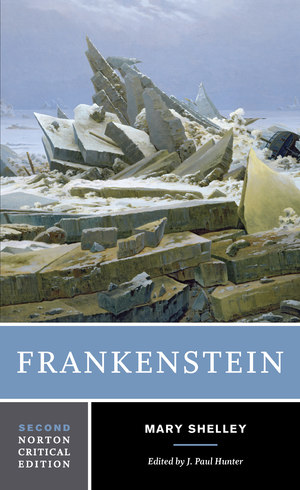
Frankenstein (1818): The Norton Critical Edition

Frankenstein, Second Edition
Norton Critical Editions
Mary Shelley (Author), J. Paul Hunter (Editor, University of Chicago)
http://books.wwnorton.com/books/webad.aspx?id=21895

Paperback
Book Details
Retail: $17.50
December 2011
ISBN: 978-0-393-92793-1
544 pages


Description:

The best-selling student edition on the market, now available in a Second Edition.

Almost two centuries after its publication, Frankenstein remains an indisputably classic text and Mary Shelley’s finest work.

This extensively revised Norton Critical Edition includes new texts and illustrative materials that convey the enduring global conversation about Frankenstein and its author. The text is that of the 1818 first edition, published in three volumes by Lackington, Hughes, Harding, Mavor, and Jones. It is accompanied by an expansive new preface, explanatory annotations, a map of Geneva and its environs, and seven illustrations, five of them new to the Second Edition.

Context is provided in three supporting sections: “Circumstance, Influence, Composition, Revision,” “Reception, Impact, Adaptation,” and “Sources, Influences, Analogues.” Among the Second Edition’s new inclusions are historical-cultural studies by Susan Tyler Hitchcock, William St. Clair, and Elizabeth Young; Chris Baldrick on the novel’s reception; and David Pirie on the novel’s many film adaptations. Related excerpts from the Bible and from John Milton’s Paradise Lost are now included, as is Charles Lamb’s poem “The Old Familiar Faces.”

“Criticism” collects sixteen major interpretations of Frankenstein, nine of them new to the Second Edition. The new contributors are Peter Brooks, Bette London, Garrett Stewart, James. A. W. Heffernan, Patrick Brantlinger, Jonathan Bate, Anne Mellor, Jane Goodall, and Christa Knellwolf.

A Chronology and Selected Bibliography are also included.


Contents

List of Illustrations

Introduction

The Text of Frankenstein

map: Geneva and Its Environs

Title page (1818)

Dedication (1818)

Preface

Frankenstein


Contexts

CIRCUMSTANCE, INFLUENCE, COMPOSITION, REVISION
  • Mary Shelley • Introduction to Frankenstein, Third Edition (1831)
  • John William Polidori • Letter Prefaced to The Vampyre (1819)
  • M. K. Joseph • The Composition of Frankenstein
  • Chris Baldick • [Assembling Frankenstein]
  • Richard Holmes • [Mary Shelley and the Power of Contemporary Science]
  • Christa Knellwolf and Jane Goodall • [The Significance of Place: Ingolstadt]
  • Charles E. Robinson • Texts in Search of an Editor: Reflections on The Frankenstein Notebooks and on Editorial Authority
  • Anne K. Mellor • Choosing a Text of Frankenstein to Teach

RECEPTION, IMPACT, ADAPTATION
  • Percy Bysshe Shelley • On Frankenstein
  • [John Croker] • From the Quarterly Review (January 1818)
  • Sir Walter Scott • From Blackwood’s Edinburgh Magazine (March 1818)
  • Edinburgh Magazine • [On Frankenstein] (March 1818)
  • Gentleman’s Magazine • [On Frankenstein] (April 1818)
  • Knight’s Quarterly • [On Frankenstein] (August–November 1824)
  • Hugh Reginald Haweis • Introduction to the Routledge World Library Edition (1886)
  • Chris Baldick • [The Reception of Frankenstein]
  • William St. Clair • [Frankenstein’s Impact]
  • Susan Tyler Hitchcock • [The Monster Lives On]
  • Elizabeth Young • [Frankenstein as Historical Metaphor]
  • David Pirie • Approaches to Frankenstein [in Film]

SOURCES, INFLUENCES, ANALOGUES
  • The Book of Genesis • [Biblical Account of Creation]
  • John Milton • From Paradise Lost
  • Percy Bysshe Shelley • Mont Blanc (1816)
  • [The Sea of Ice] (1817)
  • Mutability
  • George Gordon, Lord Byron • Prometheus
  • Darkness
  • From Childe Harold’s Pilgrimage, Canto III (1816)
  • Charles Lamb • The Old Familiar Faces 

Criticism

George Levine • Frankenstein and the Tradition of Realism

Ellen Moers • Female Gothic: The Monster’s Mother

Sandra M. Gilbert and Susan Gubar • Mary Shelley’s Monstrous Eve

Mary Poovey • “My Hideous Progeny”: The Lady and the Monster

Anne K. Mellor • Possessing Nature: The Female in Frankenstein

Peter Brooks • What Is a Monster? (According to Frankenstein)

Bette London • Mary Shelley, Frankenstein, and the Spectacle of Masculinity

Marilyn Butler • Frankenstein and Radical Science

Lawrence Lipking • Frankenstein, the True Story; or, Rousseau Judges Jean-Jacques

Garrett Stewart • In the Absence of Audience: Of Reading and Dread in Mary Shelley

James A. W. Heffernan • Looking at the Monster: Frankenstein and Film

Patrick Brantlinger • The Reading Monster

Jonathan Bate • [Frankenstein and the State of Nature]

Anne K. Mellor • Frankenstein, Racial Science, and the Yellow Peril

Jane Goodall • Electrical Romanticism

Christa Knellwolf • Geographic Boundaries and Inner Space: Frankenstein, Scientific Exploration, and the Quest for the Absolute


Mary Shelley: A Chronology

Selected Bibliography


Glut's The Frankenstein Archive

From the master of Frankensteiniana:

The Frankenstein Archive: Essays on the Monster, the Myth, the Movies, and More
Donald F. Glut
http://www.mcfarlandbooks.com/book-2.php?id=978-0-7864-1353-9

Price: $35.00
Print ISBN: 978-0-7864-1353-9
Ebook ISBN: 978-0-7864-8069-2
55 photos, index
233pp. softcover (6 x 9) 2002
Available for immediate shipment


About the Book

Mary Wollstonecraft Shelley’s classic novel Frankenstein: or, The Modern Prometheus, first published in 1818, started a phenomeon that has survived the years and permeated many aspects of popular culture. It has spawned numerous films, television programs, books, comics, stage presentations, and the like, and continues to do so today.

Like the Frankenstein Monster, this work is made up of many individual parts, some of which are quite different in their specific themes, but all of which relate to Frankenstein in some way. They consider the untold true story of Frankenstein, Glenn Strange’s portrayals of the Monster, the portrayals of lesser-known actors who played the character, Peter Cushing and his role as Baron (and Dr.) Frankenstein, the classic film Young Frankenstein co-written by Mel Brooks and Gene Wilder (who also starred in it), the battles between do-gooders and the Monster and other horror figures, Frankenstein in cartoons—and much more.

Each of the 15 essays, all written by the author, is prefaced with explanatory notes that place the essay in its historical perspective, comment on its origin and content, and where appropriate, supplement the text with new, additional, or otherwise relevant information. Richly illustrated.


Table of Contents

Preface 1

1 Frankenstein: The (Untold) True Story 5

2 The "Strange" Frankenstein Monster 34

3 A Forgotten Frankenstein? 49

4 Peter Cushing: "Dr. Frankenstein, I Presume" 58

5 Young Frankenstein--Classic in the Making 66

6 Super-Heroes vs. Frankenstein (and Company) 81

7 "What’s Up, Doc Frankenstein (Jekyll and Fu Manchu)?" 96

8 The Beatles Meet Frankenstein 112

9 A Score of Frankenstein Misconceptions 117

10 Frankenstein on the Home-Movie Screen 138

11 "This Is Your Life, Frankenstein’s Monster" 152

12 Frankenstein Sings-and Dances, Too 157

13 Frankenstein in Four Colors 164

14 The Monster of Frankenstein (Almost) Returns 189

15 The New Adventures of Frankenstein 202

Index 217


About the Author

Donald F. Glut is a prolific book and article writer, and movie producer-director. He is the president of Frontline Entertainment and lives in Burbank, California.


Friedman and Kavey's Monstrous Progeny

Monstrous Progeny: A History of the Frankenstein Narratives
By Lester D. Friedman, Allison B. Kavey
https://www.rutgersuniversitypress.org/monstrous-progeny/9780813564234


256 pages, 37 photographs, 152.4 x 228.6

Paperback,August 1, 2016,$27.95
978-0-8135-6423-4

Cloth Over Boards,August 1, 2016,$90.00
978-0-8135-6424-1

PDF,August 1, 2016,$27.95
978-0-8135-6425-8

EPUB,August 1, 2016,$27.95
978-0-8135-7370-0


About This Book

Mary Shelley’s 1818 novel Frankenstein is its own type of monster mythos that will not die, a corpus whose parts keep getting harvested to animate new artistic creations. What makes this tale so adaptable and so resilient that, nearly 200 years later, it remains vitally relevant in a culture radically different from the one that spawned its birth?

Monstrous Progeny takes readers on a fascinating exploration of the Frankenstein family tree, tracing the literary and intellectual roots of Shelley’s novel from the sixteenth century and analyzing the evolution of the book’s figures and themes into modern productions that range from children’s cartoons to pornography. Along the way, media scholar Lester D. Friedman and historian Allison B. Kavey examine the adaptation and evolution of Victor Frankenstein and his monster across different genres and in different eras. In doing so, they demonstrate how Shelley’s tale and its characters continue to provide crucial reference points for current debates about bioethics, artificial intelligence, cyborg lifeforms, and the limits of scientific progress.

Blending an extensive historical overview with a detailed analysis of key texts, the authors reveal how the Frankenstein legacy arose from a series of fluid intellectual contexts and continues to pulsate through an extraordinary body of media products. Both thought-provoking and entertaining, Monstrous Progeny offers a lively look at an undying and significant cultural phenomenon.


Table of Contents

Acknowledgments

Introduction: Singing the Body Electric

1 In a Country of Eternal Light: Frankenstein’s Intellectual History

2 The Instruments of Life: Frankenstein’s Medical History

3 A More Horrid Contrast: From the Page to the Stage

4 It’s Still Alive: The Universal and Hammer Movie Cycles

5 The House of Frankenstein: Mary Shelley’s Step Children

6 Fifty Ways to Leave Your Monster

Notes

Select Bibliography

Index


About the Authors

LESTER D. FRIEDMAN is a professor and former chair of the Media and Society Program at Hobart and William Smith Colleges in Geneva, New York. He is the author, coauthor, or editor of over twenty books including American Cinema of the 1970s (Rutgers University Press) and the forthcoming, Tough Ain’t Enough.

ALLISON B. KAVEY is an associate professor of early modern history at CUNY John Jay College of Criminal Justice and the CUNY Graduate Center in New York, New York. She is the author, coauthor, or editor of several books including Second Star to the Right: Peter Pan in the Cultural Imagination, co-edited with Friedman (Rutgers University Press).


Sunday, August 13, 2017

Picart on Frankenstein from 2003

A final one for the night:

Remaking the Frankenstein Myth on Film: Between Laughter and Horror
Caroline Joan S. Picart - Author
SUNY series in Psychoanalysis and Culture
http://www.sunypress.edu/p-3777-remaking-the-frankenstein-myth-.aspx

Hardcover - 268 pages
Release Date: July 2003
ISBN10: 0-7914-5769-9
ISBN13: 978-0-7914-5769-6

Price: $33.95 (listed as Out of Print)
Paperback - 268 pages
Release Date: July 2003
ISBN10: 0-7914-5770-2
ISBN13: 978-0-7914-5770-2

Available as a Google eBook for other eReaders and tablet devices.


Summary 

Explores how filmmakers and screenwriters have used comedy and science fiction to extend the boundaries of the Frankenstein narrative.

Focusing on films outside the horror genre, this book offers a unique account of the Frankenstein myth's popularity and endurance. Although the Frankenstein narrative has been a staple in horror films, it has also crossed over into other genres, particularly comedy and science fiction, resulting in such films as Abbott and Costello Meet Frankenstein, Young Frankenstein, The Rocky Horror Picture Show, Bladerunner, and the Alien and Terminator film series. In addition to addressing horror's relationship to comedy and science fiction, the book also explores the versatility and power of the Frankenstein narrative as a contemporary myth through which our deepest attitudes concerning gender (masculine versus feminine), race (Same versus Other), and technology (natural versus artificial) are both revealed and concealed. The book not only examines the films themselves, but also explores early drafts of film scripts, scenes that were cut from the final releases, publicity materials, and reviews, in order to consider more fully how and why the Frankenstein myth continues to resonate in the popular imagination.

“…invites readers to explore an innovative take on horror film genres and gender. Picart’s exploration of the three shadows as well as her claim that hybrid forms of horror create opportunities for empowerment pose for the interested reader a challenge: to expand and adapt her insights in our own hybrid explorations of gender and film.” — Women and Language

"Picart tells a story of the story of every film in a gifted way; this takes talent, as well as a thorough familiarity with the films and a genuine enthusiasm for them." — Joseph Natoli, author of Memory's Orbit: Film and Culture 1999–2000

"Picart displays an assurance and command of a complex historical and critical field, which she handles with considerable focus and lucidity. She argues that the fairly rigid sexual politics of the earlier, classic Frankenstein films give way to a more complex set of visions when taken up in various comic and science fiction treatments. Her work is more than a mere commentary on earlier scholarship—it is a real advance and stands on its own as the book to read." — Thomas W. Benson, coauthor of Reality Fictions: The Films of Frederick Wiseman

Caroline Joan S. Picart is Assistant Professor of English and Humanities and Courtesy Assistant Professor of Law at Florida State University. She is the author of The Cinematic Rebirths of Frankenstein: Universal, Hammer, and Beyond and the coauthor (with Frank Smoot and Jayne Blodgett) of The Frankenstein Film Sourcebook.


Table of Contents

Acknowledgments

1. Frankenstein as Enduring Cinemyth

2. (Un)Leashing Laughter: Gender, Power, and Humor

3. Daemonic Dread

4. On the Edge of Terror and Humor

5. Postmodern Horror-Hilarity

Notes

Bibliography

About the Author

Index