Celebrating in 2026: the 105th anniversary of the lost film Il Mostro di Frankenstein (1921); the 95th anniversary of Universal Studios’ Frankenstein (1931); the 60th anniversary of Dell Comics’ superhero version of Frankenstein (1966), Hanna Barbera’s television hero Frankenstein Jr, co-star of the series Frankenstein Jr. and The Impossibles (1966), and the films Jesse James Meets Frankenstein's Daughter (1966) and The War of the Gargantuas (1966); the 55th anniversary of General Mills’ cereal mascot Franken Berry (1971); the 50th anniversary of the Saturday-morning television series Monster Squad (1976); the 45th anniversary of the anime film Kyofu Densetsu: Kaiki! Furankenshutain (1981); the 40th anniversary of Ken Russell’s film Gothic (1986) and Fred Saberhagen’s novel The Frankenstein Papers (1986); the 25th anniversary of Curtis Jobling’s picture book Frankenstein's Cat (2001); the 20th anniversary of Grant Morrision’s comic book series Seven Soldiers: Frankenstein (2006); the 15th anniversary of Nick Dear’s play Frankenstein (2011); the 10th anniversary of the Royal Ballet's production of Frankenstein (2016); and the release of Maggie Gyllenhaal’s film Bride! (2026).
Showing posts with label Popular Culture. Show all posts

Saturday, June 23, 2018

CFP Frankenstein Unbound: An Interdisciplinary Conference Exploring Mary Shelley and Gothic Legacies (6/29/2018; Bournemouth 10/31-11/01/2018)

Finally, a call that is current (though only barely):


Frankenstein Unbound: An Interdisciplinary Conference Exploring Mary Shelley and Gothic Legacies
https://call-for-papers.sas.upenn.edu/cfp/2018/05/03/frankenstein-unbound-an-interdisciplinary-conference-exploring-mary-shelley-and

deadline for submissions: June 29, 2018

full name / name of organization: Arts University Bournemouth

contact email: frankensteinunboundconference@gmail.com


DEADLINE FOR ABSTRACTS EXTENDED: 29th June 2018

Dates: Wednesday 31 October and Thursday 1 November 2018

Venues: Conference - St Peter’s Church, Bournemouth


Keynote Speakers:

Sir Christopher Frayling, Chancellor, Arts University Bournemouth

Professor Elaine Graham, University of Chester

Professor Sir Peter Cooke, CRAB Studios (TBC)


In 1849, Mary Shelley and Percy Shelley’s heart were brought to the graveyard of St. Peter’s Church in Bournemouth, where they were buried with the remains of Mary Shelley’s parents Mary Wollstonecraft and William Godwin.

In 2018, Arts University Bournemouth and St. Peter’s Church, in association with Bournemouth University, celebrate the bicentenary of the publication of Mary Shelley’s most famous work Frankenstein, or the Modern Prometheus (1818) as part of the Shelley Frankenstein Festival. The academic conference, located at this unique venue, will offer new and re-situated perspectives on Mary Shelley and her writings, her family and circle, and her most famous work. We are pleased to acknowledge colleagues at Bournemouth University for their organisational support.

We invite papers and presentations themed around, but not limited to, the following:

  • Mary Shelley, Percy Shelley, and the Romantics
  • Mary Wollstonecraft and Mary Shelley
  • Mary Shelley beyond Frankenstein
  • The Shelley family: history and legacy
  • Monstrous Romantics
  • Frankenstein and the sea
  • Theology and Frankenstein
  • Frankenstein and philosophy
  • Frankenstein at home and abroad
  • Adaptations and afterlives
  • Frankenstein and medical humanities
  • The abject and the sublime
  • Frankenstein and emotion
  • Guilt and crime in Frankenstein
  • Interpretations of Frankenstein in the creative industries (Film, Art, Theatre, Dance, Writing etc)
  • Mary Shelley and Gothic legacies
  • Gothic architecture
  • The Gothic imagination

We welcome proposals for themed panel sessions (maximum three papers), individual twenty-minute presentations, or creative submissions from practitioners and scholars of all fields. We particularly encourage submissions from post-graduate students and Early Career Researchers. Please submit an abstract (300 words) and short biography (100 words) to frankensteinunboundconference@gmail.com by Friday 29th June 2018.

For more information and updates visit our website: https://frankensteinunbound.wordpress.com/.

CFP Frankenstein: Two Hundred Years of Monsters Conference (expired)

Came across this by accident today; sadly, it is also expired.

Frankenstein: Two Hundred Years of Monsters
http://hrc.cass.anu.edu.au/events/frankenstein-two-hundred-years-monsters


- Call for Papers -

Frankenstein 2018: Two Hundred Years of Monsters

12 ‐ 15 September 2018
The Australian National University and the National Film and Sound Archive, Canberra


Nearly two centuries after its anonymous publication on 1 January 1818, Mary Shelley’s Frankenstein or, The Modern Prometheus remains as topical as ever. Its core story - of a recklessly ambitious and naïve scientist whose artificial, human-like creature arouses only horror and disgust, and escapes control to seek revenge on his creator - has become, for better or worse, the techno‐scientific fable of modernity. First adapted for stage by Richard Brinsley Peake in 1823, and for film by Edison Studios in 1910, the story has inspired more theatre, film, television and other adaptations than any other modern narrative, with more than 50 screen adaptations appearing in the 2010s alone. From Fritz Lang’s Metropolis to Alex Garland’s Ex Machina, and The Rocky Horror Picture Show to The Addams Family, the Frankenstein myth reaches into every recess of high and popular culture.

We invite proposals for 20-­minute papers or 3 x 20‐minute panel sessions from scholars across the humanities, sciences, and social sciences that respond in interdisciplinary ways to this most interdisciplinary of novels, including, but not limited to:

  • Literary studies, especially of the long eighteenth century, Romanticism, Victorian and neo­‐Victorian literature
  • Re-tellings and re-­‐imaginings of the Frankenstein story in various modes and genres, e.g. SF, steampunk, speculative fiction, slash fiction, etc.
  • Film, television, theatre and performance, and visual studies
  • Digital humanities, reception studies, histories of popular culture, and media ecologies
  • Gender studies, queer theory, and the history of sexuality
  • Disability studies and post‐humanism
  • The history of medicine, especially reproductive technologies
  • Science and technology studies; images and imaginaries of science and scientists
  • The history and philosophy of biology, especially in relation to vitalism
  • Eco‐criticism and the Anthropocene
  • Affect theory and the history of emotions
  • Frankenstein and race, colonialism, empire
  • Global and local Frankensteins, e.g. Australian Frankensteins
  • Frankenstein and material history
  • Cyborgs, robots, artificial intelligence, and machine learning
  • Synthetic biology, genetic engineering, and artificial life

To maintain order among this menagerie of monsters, we propose the following four overarching themes, each of which will be addressed by one of our keynote speakers:

Frankenstein in 1818: historicising the monster
(Professor Sharon Ruston, Lancaster)

Frankenstein as scientific fable: from grave-­‐robbing and galvanism to synthetic biology and machine learning
(Professor Genevieve Bell, Australian National University)

Adaptation and experimentation: Frankenstein in film and other media
(Assistant Professor Shane Denson, Stanford)

Frankenstein’s queer family: gender, sexuality, reproduction and the work of care
(Professor Julie Carlson, University of California, Santa Barbara)


Please send proposals for papers or sessions - including a title, 250­‐word abstract, and brief author biography - to Dr Russell Smith at russell.smith@anu.edu.au.

The deadline for proposals is 6 April 2018. Proposals will be reviewed by a committee comprising scholars from the humanities, sciences, and social sciences, and applicants will be informed of the outcome within two weeks of the submission deadline. Please note that we will endeavour to notify overseas applicants earlier if they submit proposals before the submission deadline.

For further information and updates, as well as information about the Humanities Research Centre’s annual theme for 2018, Imagining Science and Technology 200 Years after Frankenstein, see here.

Please direct any inquiries to Penny Brew at hrc@anu.edu.au.


Tuesday, June 12, 2018

Frankenstein and Its Classics

Due out this summer:
Frankenstein and Its Classics: The Modern Prometheus from Antiquity to Science Fiction
https://www.bloomsbury.com/us/frankenstein-and-its-classics-9781350054875/
Editor(s): Benjamin Eldon Stevens, Jesse Weiner, Brett M. Rogers

Published: 08-09-2018
Format: Paperback
Edition: 1st
Extent: 288
ISBN: 9781350054875
Imprint: Bloomsbury Academic
Series: Bloomsbury Studies in Classical Reception
Illustrations: 14 bw illus
Dimensions: 6 1/8" x 9 1/4"
List price: $29.95

Also available in hardcover and ebook formats.


About Frankenstein and Its Classics

Frankenstein and Its Classics is the first collection of scholarship dedicated to how Frankenstein and works inspired by it draw on ancient Greek and Roman literature, history, philosophy, and myth. Presenting twelve new essays intended for students, scholars, and other readers of Mary Shelley's novel, the volume explores classical receptions in some of Frankenstein's most important scenes, sources, and adaptations. Not limited to literature, the chapters discuss a wide range of modern materials-including recent films like Alex Garland's Ex Machina and comics like Matt Fraction's and Christian Ward's Ody-C-in relation to ancient works including Hesiod's Theogony, Aeschylus's Prometheus Bound, Ovid's Metamorphoses, and Apuleius's The Golden Ass.

All together, these studies show how Frankenstein, a foundational work of science fiction, brings ancient thought to bear on some of today's most pressing issues, from bioengineering and the creation of artificial intelligence to the struggles of marginalized communities and political revolution. This addition to the comparative study of classics and science fiction reveals deep similarities between ancient and modern ways of imagining the world-and emphasizes the prescience and ongoing importance of Mary Shelley's immortal novel. As Frankenstein turns 200, its complex engagement with classical traditions is more significant than ever.


Table of contents

Introduction: The Modern Prometheus Turns 200
Jesse Weiner, Hamilton College, USA; Benjamin Eldon Stevens, Trinity University, USA;
Brett M. Rogers, University of Puget Sound, USA

Section 1: Promethean Heat

1. Patchwork Paratexts and Monstrous Metapoetics: “After tea M reads Ovid”
Genevieve Liveley, University of Bristol, UK

2. Prometheus and Dr. Darwin's Vermicelli: Another Stir to the Frankenstein Broth
Martin Priestman, University of Roehampton, UK

3. The Politics of Revivification in Lucan's Bellum Civile and Mary Shelley's Frankenstein
Andrew McClellan, University of Delaware, USA

4. Romantic Prometheis and the Molding of Frankenstein
Suzanne L. Barnett, Francis Marion University

5. Why “The Year without a Summer”?
David A. Gapp, Hamilton College, USA

6. The Sublime Monster: Frankenstein, or The Modern Pandora
Matthew Gumpert, Bogaziçi University, Turkey

Section 2: Hideous Progeny

7. Cupid and Psyche in Frankenstein: Mary Shelley's Apuleian Science Fiction?
Benjamin Eldon Stevens, Trinity University, USA

8. “The Pale Student of Unhallowed Arts”: Frankenstein, Aristotle, and the Wisdom of Lucretius
Carl A. Rubino, Hamilton College, USA

9. Timothy Leary and the Psychodynamics of Stealing Fire
Nese Devenot, University of Puget Sound, USA

10. Frankenfilm: Classical Monstrosity in Bill Morrison's Spark of Being
Jesse Weiner, Hamilton College, USA

11. Alex Garland's Ex Machina or The Modern Epimetheus: Science Fiction after Mary Shelley
Emma Hammond, University of Bristol, UK

12. The Postmodern Prometheus and Posthuman Reproductions in Science Fiction
Brett M. Rogers, University of Puget Sound, USA

Suggestions for Further Reading: Other Modern Prometheis
Sam Cooper, Bard High School Early Colleges Queens, USA

Works cited
Index


Reviews

Frankenstein's patchwork of classical allusions were as diverse and uncanny as the monster itself. Putting Prometheus back into the “promethean”, this timely and exciting volume shows how classical mythology, refracted through Frankenstein, shapes ethical debates prompted by technological and scientific advances today.” – Jennifer Wallace, Harris Fellow and Director of Studies in English, Peterhouse, University of Cambridge, UK.

“This highly scholarly, yet very accessible, collection grounds the original Frankenstein and adaptations of it in numerous ancient Greco-Roman sources, some for the first time and all with a revealing thoroughness unavailable until now.” – Jerrold E. Hogle, Professor of English and University Distinguished Professor, University of Arizona, USA.

Monday, August 14, 2017

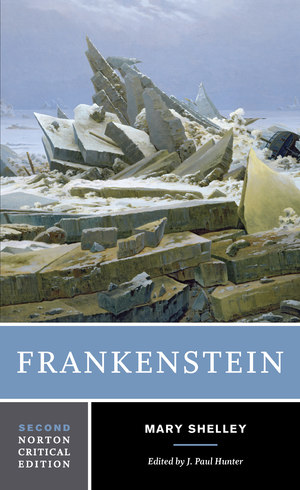
Frankenstein (1818): The Norton Critical Edition

Frankenstein, Second Edition
Norton Critical Editions
Mary Shelley (Author), J. Paul Hunter (Editor, University of Chicago)
http://books.wwnorton.com/books/webad.aspx?id=21895

Paperback
Book Details
Retail: $17.50
December 2011
ISBN: 978-0-393-92793-1
544 pages


Description:

The best-selling student edition on the market, now available in a Second Edition.

Almost two centuries after its publication, Frankenstein remains an indisputably classic text and Mary Shelley’s finest work.

This extensively revised Norton Critical Edition includes new texts and illustrative materials that convey the enduring global conversation about Frankenstein and its author. The text is that of the 1818 first edition, published in three volumes by Lackington, Hughes, Harding, Mavor, and Jones. It is accompanied by an expansive new preface, explanatory annotations, a map of Geneva and its environs, and seven illustrations, five of them new to the Second Edition.

Context is provided in three supporting sections: “Circumstance, Influence, Composition, Revision,” “Reception, Impact, Adaptation,” and “Sources, Influences, Analogues.” Among the Second Edition’s new inclusions are historical-cultural studies by Susan Tyler Hitchcock, William St. Clair, and Elizabeth Young; Chris Baldrick on the novel’s reception; and David Pirie on the novel’s many film adaptations. Related excerpts from the Bible and from John Milton’s Paradise Lost are now included, as is Charles Lamb’s poem “The Old Familiar Faces.”

“Criticism” collects sixteen major interpretations of Frankenstein, nine of them new to the Second Edition. The new contributors are Peter Brooks, Bette London, Garrett Stewart, James. A. W. Heffernan, Patrick Brantlinger, Jonathan Bate, Anne Mellor, Jane Goodall, and Christa Knellwolf.

A Chronology and Selected Bibliography are also included.


Contents

List of Illustrations

Introduction

The Text of Frankenstein

map: Geneva and Its Environs

Title page (1818)

Dedication (1818)

Preface

Frankenstein


Contexts

CIRCUMSTANCE, INFLUENCE, COMPOSITION, REVISION
  • Mary Shelley • Introduction to Frankenstein, Third Edition (1831)
  • John William Polidori • Letter Prefaced to The Vampyre (1819)
  • M. K. Joseph • The Composition of Frankenstein
  • Chris Baldick • [Assembling Frankenstein]
  • Richard Holmes • [Mary Shelley and the Power of Contemporary Science]
  • Christa Knellwolf and Jane Goodall • [The Significance of Place: Ingolstadt]
  • Charles E. Robinson • Texts in Search of an Editor: Reflections on The Frankenstein Notebooks and on Editorial Authority
  • Anne K. Mellor • Choosing a Text of Frankenstein to Teach

RECEPTION, IMPACT, ADAPTATION
  • Percy Bysshe Shelley • On Frankenstein
  • [John Croker] • From the Quarterly Review (January 1818)
  • Sir Walter Scott • From Blackwood’s Edinburgh Magazine (March 1818)
  • Edinburgh Magazine • [On Frankenstein] (March 1818)
  • Gentleman’s Magazine • [On Frankenstein] (April 1818)
  • Knight’s Quarterly • [On Frankenstein] (August–November 1824)
  • Hugh Reginald Haweis • Introduction to the Routledge World Library Edition (1886)
  • Chris Baldick • [The Reception of Frankenstein]
  • William St. Clair • [Frankenstein’s Impact]
  • Susan Tyler Hitchcock • [The Monster Lives On]
  • Elizabeth Young • [Frankenstein as Historical Metaphor]
  • David Pirie • Approaches to Frankenstein [in Film]

SOURCES, INFLUENCES, ANALOGUES
  • The Book of Genesis • [Biblical Account of Creation]
  • John Milton • From Paradise Lost
  • Percy Bysshe Shelley • Mont Blanc (1816)
  • [The Sea of Ice] (1817)
  • Mutability
  • George Gordon, Lord Byron • Prometheus
  • Darkness
  • From Childe Harold’s Pilgrimage, Canto III (1816)
  • Charles Lamb • The Old Familiar Faces 

Criticism

George Levine • Frankenstein and the Tradition of Realism

Ellen Moers • Female Gothic: The Monster’s Mother

Sandra M. Gilbert and Susan Gubar • Mary Shelley’s Monstrous Eve

Mary Poovey • “My Hideous Progeny”: The Lady and the Monster

Anne K. Mellor • Possessing Nature: The Female in Frankenstein

Peter Brooks • What Is a Monster? (According to Frankenstein)

Bette London • Mary Shelley, Frankenstein, and the Spectacle of Masculinity

Marilyn Butler • Frankenstein and Radical Science

Lawrence Lipking • Frankenstein, the True Story; or, Rousseau Judges Jean-Jacques

Garrett Stewart • In the Absence of Audience: Of Reading and Dread in Mary Shelley

James A. W. Heffernan • Looking at the Monster: Frankenstein and Film

Patrick Brantlinger • The Reading Monster

Jonathan Bate • [Frankenstein and the State of Nature]

Anne K. Mellor • Frankenstein, Racial Science, and the Yellow Peril

Jane Goodall • Electrical Romanticism

Christa Knellwolf • Geographic Boundaries and Inner Space: Frankenstein, Scientific Exploration, and the Quest for the Absolute


Mary Shelley: A Chronology

Selected Bibliography


Glut's The Frankenstein Archive

From the master of Frankensteiniana:

The Frankenstein Archive: Essays on the Monster, the Myth, the Movies, and More
Donald F. Glut
http://www.mcfarlandbooks.com/book-2.php?id=978-0-7864-1353-9

Price: $35.00
Print ISBN: 978-0-7864-1353-9
Ebook ISBN: 978-0-7864-8069-2
55 photos, index
233pp. softcover (6 x 9) 2002
Available for immediate shipment


About the Book

Mary Wollstonecraft Shelley’s classic novel Frankenstein: or, The Modern Prometheus, first published in 1818, started a phenomeon that has survived the years and permeated many aspects of popular culture. It has spawned numerous films, television programs, books, comics, stage presentations, and the like, and continues to do so today.

Like the Frankenstein Monster, this work is made up of many individual parts, some of which are quite different in their specific themes, but all of which relate to Frankenstein in some way. They consider the untold true story of Frankenstein, Glenn Strange’s portrayals of the Monster, the portrayals of lesser-known actors who played the character, Peter Cushing and his role as Baron (and Dr.) Frankenstein, the classic film Young Frankenstein co-written by Mel Brooks and Gene Wilder (who also starred in it), the battles between do-gooders and the Monster and other horror figures, Frankenstein in cartoons—and much more.

Each of the 15 essays, all written by the author, is prefaced with explanatory notes that place the essay in its historical perspective, comment on its origin and content, and where appropriate, supplement the text with new, additional, or otherwise relevant information. Richly illustrated.


Table of Contents

Preface 1

1 Frankenstein: The (Untold) True Story 5

2 The "Strange" Frankenstein Monster 34

3 A Forgotten Frankenstein? 49

4 Peter Cushing: "Dr. Frankenstein, I Presume" 58

5 Young Frankenstein--Classic in the Making 66

6 Super-Heroes vs. Frankenstein (and Company) 81

7 "What’s Up, Doc Frankenstein (Jekyll and Fu Manchu)?" 96

8 The Beatles Meet Frankenstein 112

9 A Score of Frankenstein Misconceptions 117

10 Frankenstein on the Home-Movie Screen 138

11 "This Is Your Life, Frankenstein’s Monster" 152

12 Frankenstein Sings-and Dances, Too 157

13 Frankenstein in Four Colors 164

14 The Monster of Frankenstein (Almost) Returns 189

15 The New Adventures of Frankenstein 202

Index 217


About the Author

Donald F. Glut is a prolific book and article writer, and movie producer-director. He is the president of Frontline Entertainment and lives in Burbank, California.


Friedman and Kavey's Monstrous Progeny

Monstrous Progeny: A History of the Frankenstein Narratives
By Lester D. Friedman, Allison B. Kavey
https://www.rutgersuniversitypress.org/monstrous-progeny/9780813564234


256 pages, 37 photographs, 152.4 x 228.6

Paperback,August 1, 2016,$27.95
978-0-8135-6423-4

Cloth Over Boards,August 1, 2016,$90.00
978-0-8135-6424-1

PDF,August 1, 2016,$27.95
978-0-8135-6425-8

EPUB,August 1, 2016,$27.95
978-0-8135-7370-0


About This Book

Mary Shelley’s 1818 novel Frankenstein is its own type of monster mythos that will not die, a corpus whose parts keep getting harvested to animate new artistic creations. What makes this tale so adaptable and so resilient that, nearly 200 years later, it remains vitally relevant in a culture radically different from the one that spawned its birth?

Monstrous Progeny takes readers on a fascinating exploration of the Frankenstein family tree, tracing the literary and intellectual roots of Shelley’s novel from the sixteenth century and analyzing the evolution of the book’s figures and themes into modern productions that range from children’s cartoons to pornography. Along the way, media scholar Lester D. Friedman and historian Allison B. Kavey examine the adaptation and evolution of Victor Frankenstein and his monster across different genres and in different eras. In doing so, they demonstrate how Shelley’s tale and its characters continue to provide crucial reference points for current debates about bioethics, artificial intelligence, cyborg lifeforms, and the limits of scientific progress.

Blending an extensive historical overview with a detailed analysis of key texts, the authors reveal how the Frankenstein legacy arose from a series of fluid intellectual contexts and continues to pulsate through an extraordinary body of media products. Both thought-provoking and entertaining, Monstrous Progeny offers a lively look at an undying and significant cultural phenomenon.


Table of Contents

Acknowledgments

Introduction: Singing the Body Electric

1 In a Country of Eternal Light: Frankenstein’s Intellectual History

2 The Instruments of Life: Frankenstein’s Medical History

3 A More Horrid Contrast: From the Page to the Stage

4 It’s Still Alive: The Universal and Hammer Movie Cycles

5 The House of Frankenstein: Mary Shelley’s Step Children

6 Fifty Ways to Leave Your Monster

Notes

Select Bibliography

Index


About the Authors

LESTER D. FRIEDMAN is a professor and former chair of the Media and Society Program at Hobart and William Smith Colleges in Geneva, New York. He is the author, coauthor, or editor of over twenty books including American Cinema of the 1970s (Rutgers University Press) and the forthcoming, Tough Ain’t Enough.

ALLISON B. KAVEY is an associate professor of early modern history at CUNY John Jay College of Criminal Justice and the CUNY Graduate Center in New York, New York. She is the author, coauthor, or editor of several books including Second Star to the Right: Peter Pan in the Cultural Imagination, co-edited with Friedman (Rutgers University Press).


Sunday, August 13, 2017

Picart on Frankenstein from 2003

A final one for the night:

Remaking the Frankenstein Myth on Film: Between Laughter and Horror
Caroline Joan S. Picart - Author
SUNY series in Psychoanalysis and Culture
http://www.sunypress.edu/p-3777-remaking-the-frankenstein-myth-.aspx

Hardcover - 268 pages
Release Date: July 2003
ISBN10: 0-7914-5769-9
ISBN13: 978-0-7914-5769-6

Price: $33.95 (listed as Out of Print)
Paperback - 268 pages
Release Date: July 2003
ISBN10: 0-7914-5770-2
ISBN13: 978-0-7914-5770-2

Available as a Google eBook for other eReaders and tablet devices.


Summary 

Explores how filmmakers and screenwriters have used comedy and science fiction to extend the boundaries of the Frankenstein narrative.

Focusing on films outside the horror genre, this book offers a unique account of the Frankenstein myth's popularity and endurance. Although the Frankenstein narrative has been a staple in horror films, it has also crossed over into other genres, particularly comedy and science fiction, resulting in such films as Abbott and Costello Meet Frankenstein, Young Frankenstein, The Rocky Horror Picture Show, Bladerunner, and the Alien and Terminator film series. In addition to addressing horror's relationship to comedy and science fiction, the book also explores the versatility and power of the Frankenstein narrative as a contemporary myth through which our deepest attitudes concerning gender (masculine versus feminine), race (Same versus Other), and technology (natural versus artificial) are both revealed and concealed. The book not only examines the films themselves, but also explores early drafts of film scripts, scenes that were cut from the final releases, publicity materials, and reviews, in order to consider more fully how and why the Frankenstein myth continues to resonate in the popular imagination.

“…invites readers to explore an innovative take on horror film genres and gender. Picart’s exploration of the three shadows as well as her claim that hybrid forms of horror create opportunities for empowerment pose for the interested reader a challenge: to expand and adapt her insights in our own hybrid explorations of gender and film.” — Women and Language

"Picart tells a story of the story of every film in a gifted way; this takes talent, as well as a thorough familiarity with the films and a genuine enthusiasm for them." — Joseph Natoli, author of Memory's Orbit: Film and Culture 1999–2000

"Picart displays an assurance and command of a complex historical and critical field, which she handles with considerable focus and lucidity. She argues that the fairly rigid sexual politics of the earlier, classic Frankenstein films give way to a more complex set of visions when taken up in various comic and science fiction treatments. Her work is more than a mere commentary on earlier scholarship—it is a real advance and stands on its own as the book to read." — Thomas W. Benson, coauthor of Reality Fictions: The Films of Frederick Wiseman

Caroline Joan S. Picart is Assistant Professor of English and Humanities and Courtesy Assistant Professor of Law at Florida State University. She is the author of The Cinematic Rebirths of Frankenstein: Universal, Hammer, and Beyond and the coauthor (with Frank Smoot and Jayne Blodgett) of The Frankenstein Film Sourcebook.


Table of Contents

Acknowledgments

1. Frankenstein as Enduring Cinemyth

2. (Un)Leashing Laughter: Gender, Power, and Humor

3. Daemonic Dread

4. On the Edge of Terror and Humor

5. Postmodern Horror-Hilarity

Notes

Bibliography

About the Author

Index


Picart on Film from 2001

More for the bookshelf:

The Cinematic Rebirths of Frankenstein: Universal, Hammer, and Beyond
by Caroline Joan (Kay) S. Picart
http://www.abc-clio.com/ABC-CLIOCorporate/product.aspx?pc=C3941C


Showcases the versatility of the Frankenstein myth as expressed in the horror genre and provides a sustained critical analysis of the story's evolution over many decades, many studios, and many different styles of filmmaking.

October 2001
Praeger
Pages: 240
Volumes: 1
Size: 6 1/8x9 1/4
Topics: Popular Culture/Film

Hardcover
978-0-275-97363-6
$84.00


Description

The Frankenstein narrative is one of cinema's most durable, and it is often utilized by the studio system and the most renegade independents alike to reveal our deepest aspirations and greatest anxieties. The films have concerned themselves with demarcations of gender, race, and technology, and this new study aims to critique the more traditional interpretations of both the narrative and its sustained popularity. From James Whale's Frankenstein (1931) through Kenneth Branagh's Mary Shelley's Frankenstein (1994), the story remains a nuanced and ultimately ambivalent one and is discussed here in all of its myriad terms: aesthetic, cultural, psychological, and mythic.

Beginning with an examination of the narrative's origins in the myth of the birth of Dionysus from the thigh of Zeus, The Cinematic Rebirths of Frankenstein goes on to consider each of the film's many incarnations, from the Universal horror films of the thirties through the British Hammer series and beyond. Moving easily between the scholarly and the popular, the book employs both primary texts-including scripts, posters, and documentation of production histories-and a rigorous, scholarly examination of the many implications of this often-misunderstood subgenre of horror cinema.


Contents:

Preface

Introduction

Envisaging the Monstrous

The Universal Series

Beyond the Universal and Hammer Series

Mythic (Im)Mortality

BibliographyIndex


For the bookshelf: The Frankenstein Film Sourcebook

A valuable resource:

The
Frankenstein Film Sourcebook
by Caroline Joan (Kay) S. Picart, Frank Smoot, Jayne Blodgett
http://www.abc-clio.com/ABC-CLIOCorporate/product.aspx?pc=B3656C


A compilation of primary and secondary information on the numerous and multifarious film incarnations of the Frankenstein narrative, ranging across horror, comedy, science fiction, pornography, and animation.


June 2001
Greenwood
Pages: 368
Volumes: 1
Size: 6 1/8x9 1/4
Topics: Popular Culture/Film

Hardcover
978-0-313-31350-9
$75.00

eBook
978-0-313-01672-1
eBook Available from ABC-CLIO


Description

The endurance of the Frankenstein narrative as a modern cinematic myth is undeniable. Its flexibility has produced classic and contemporary horror film-most notably the Universal films of the thirties-but it has also resulted in unusual hybrids, such as musical horror-comedy (The Rocky Horror Picture Show), hyperbolic parody (Flesh for Frankenstein), and science fiction (the Alien and Terminator series). This sourcebook provides a complete guide to all of the story's filmic incarnations-including essential information such as cast, creative personnel, and plot summaries-and also guides the reader to relevant primary texts such as scripts, posters, production histories, and newspaper clippings. Utilizing an approach that is both popular and scholarly, and including spotlight essays that deal with contemporary academic approaches to the subject, The Frankenstein Film Sourcebook reveals the depth of the cinematic range of interpretations of a classic modern myth.

Comprehensive in its scope, The Frankenstein Film Sourcebook provides an alphabetical guide to two hundred films that incorporate the Frankenstein narrative. It also delves into both primary and secondary perspectives and includes discussions of aspects of the films, such as their depiction of women, which is relevant to current scholarly critiques.


Contents

Foreword by Noël Carroll

Introduction by Caroline Joan S. Picart

A Note on the Entries

An Alphabetical Listing of Frankenstein Films

Appendix One: General Texts on Frankenstein Films

Appendix Two: "Body Parts" Films

Appendix Three: "Re-Animation" Films


Tuesday, July 11, 2017

Fisch's Frankenstein: Icon of Modern Culture

The looks comparable to Hitchcock's book in term of offering a comprehensive history of the Frankenstein tradition, but the sections are broken into smaller units and (I think) it has more illustrations. Sadly, it appears out of print. 

Frankenstein: Icon of Modern Culture
http://www.helm-information.co.uk/frankenstein.htm
Audrey A. Fisch
Series: Icons of Modern Culture

Helm Information


Books details:

978-1-903206-20-1
320pp
55 illustrations
RRP £38
April 2009


Description:

This is the fifth book in the Icons of Modern Culture series. Children and adults the world over know the lumbering, overlarge figure with the green face and bolts in his head. How did the Halloween staple known as "Frankenstein" emerge out of the anonymous novel by a "young girl," published in 1818 to mixed reviews? The answer, as this study makes clear, is that the "Frankenstein" we know today is not solely Mary Shelley’s progeny. "Frankenstein" morphed into many different forms over time, place, and genre. This volume displays and analyses the many post-Shelley "Frankensteins," exploring their continuities and disjunctions in order to trace the development of this enduring icon. The volume also traces the complex history of Mary Shelley’s Frankenstein, including its publishing history, its dismissal by the literary establishment, and its subsequent reclamation as a touchstone text in high school and college classrooms. Students of Shelley’s novel or of the many "Frankensteins" her novel propagated will find here an analysis of this intriguing cultural history. This volume also provides extensive extracts, gathering together an unprecedented collection of both never-before published and previously published material, so that readers can read widely and develop their own sense of "Frankenstein’s" place in our world.


Table of Contents:


List of Illustrations

Acknowledgements

Series Editor’s Preface


Introduction


Section 1 – Mary Shelley and the first "Frankensteins"

1. Publication

2. Frankenstein, Godwin, and Wollstonecraft

3. Reception

4. Early Science

5. The Nature of Man

6. Percy Shelley and Frankenstein

7. Mary Shelley and Frankenstein

8. Revision and Authorship


Section 2 – Beyond Mary Shelley

9. Early Theatre 1823–1826

10. Victorian Burlesque-Extravaganza

11. Other Victorian "Frankensteins"

12. Silent Film

13. Early Twentieth-Century Drama

14. Whale, Hammer, and Beyond

15. Feminist Canonisation

16. Critical Progeny

17. The Scientific Legacy of "Frankenstein"

18. Contemporary "Frankenstein"


Conclusion: Ubiquitous "Frankenstein"


Appendix: "The Death Bride" from Tales of the Dead


Bibliography


Index


About the author:

Audrey A. Fisch is Professor of English and Coordinator of Secondary English Education at New Jersey City University. She is the editor of The Other Mary Shelley: Beyond Frankenstein and The Cambridge Companion to the African American Slave Narrative and the author of American Slaves in Victorian England: Abolitionist Politics in Popular Literature and Culture.

Cambridge Companion to Mary Shelley

A great overview of Mary Shelley and her writings. It includes a number of pieces on Frankenstein and the Frankenstein tradition:

The Cambridge Companion to Mary Shelley
http://www.cambridge.org/us/academic/subjects/literature/english-literature-1700-1830/cambridge-companion-mary-shelley
Part of Cambridge Companions to Literature
Editor: Esther Schor, Princeton University, New Jersey

Product details

Date Published: January 2004
format: Paperback
isbn: 9780521007702
length: 316 pages
dimensions: 229 x 154 x 21 mm
weight: 0.52kg
contains: 14 b/w illus.

$ 30.99 (Paperback )
Other available formats:Hardback, eBook


Description

Well-known scholars review Mary Shelley's work in several contexts (literary history, aesthetic and literary culture, the legacies of her parents) and also analyze her most famous work-- Frankenstein. The contributors also examine Shelley as a biographer, cultural critic, and travel writer. The text is supplemented by a chronology, guide to further reading and select filmography.

  • Covers a wide range of topics in a clear and comprehensive way
  • The volume is well supported by a detailed chronology, bibliography and select filmography
  • Offers treatments of film and popular culture in addition to literary and cultural criticism approaches


Table of Contents

Chronology

Introduction Esther Schor (online)

Part I. 'The Author of Frankenstein':
1. Making a 'monster': an introduction to Frankenstein Anne K. Mellor (online)
2. Frankenstein, Matilda, and the legacies of Godwin and Wollstonecraft Pamela Clemit
3. Frankenstein, feminism, and literary theory Diane Long Hoeveler
4. Frankenstein on Film Esther Schor
5. Frankenstein's futurity: from replicants to robotics Jay Clayton


Part II. Fictions and Myths:
6. Valperga Stuart Curran
7. The last man Kari E. Lokke
8. Historical novelist Deidre Lynch
9. Falkner and other fictions Kate Ferguson Ellis
10. Stories for the Keepsake Charlotte Sussman
11. Proserpine and Midas Judith Pascoe

Part III. Professional Personae:
12. Mary Shelley, editor Susan J. Wolfson
13. Letters: the public/private self Betty T. Bennett
14. Mary Shelley as biographer Greg Kucich
15. Mary Shelley's travel writing Jeanne Moskal
16. Mary Shelley as cultural critic Timothy Morton

Further reading

Selected filmography.

Must Read: Hitchcock's Frankenstein: A Cultural History

A masterful survey of the Frankenstein tradition:

Frankenstein:A Cultural History
By Susan Tyler Hitchcock
W. W. Norton
http://books.wwnorton.com/books/978-0-393-06144-4/

Book Details
Hardcover
October 2007
ISBN 978-0-393-06144-4
5.9 × 8.5 in / 400 pages

Sales Territory: Worldwide including Canada, but excluding the British Commonwealth.


Overview

A lively history of the Frankenstein myth, tracing its evolution from a Romantic nightmare to its prominence in today's imaginative landscape.

Frankenstein began as the nightmare of an unwed teenage mother in Geneva, Switzerland, in 1816. At a time when the moral universe was shifting and advances in scientific knowledge promised humans dominion over that which had been God's alone, Mary Shelley envisioned a story of human presumption and its misbegotten consequences. Two centuries later, that story is still constantly retold and reinterpreted, from Halloween cartoons to ominous allusions in the public debate, capturing and conveying meaning central to our consciousness today and our concerns for tomorrow. From Victorian musical theater to Boris Karloff with neck bolts, to invocations at the President's Council on Bioethics, the monster and his myth have inspired everyone from cultural critics to comic book addicts. This is a lively and eclectic cultural history, illuminated with dozens of pictures and illustrations, and told with skill and humor. Susan Tyler Hitchcock uses film, literature, history, science, and even punk music to help us understand the meaning of this monster made by man.


Contents (from WorldCat)

Conception --
Birth and lineage --
Reception and revision --
The monster lives on --
Making more monsters --
A monster for modern times --
A brave new world of monsters --
The horror and the humor --
Monsters in the living room --
Taking the monster seriously --
The monster and his myth today.


Thursday, February 9, 2017

CFP Romanticism and Popular Culture (5/15/2017; SAMLA)

Of potential interest:

Romanticism and Popular Culture

Event: 11/03/2017 - 11/05/2017
Abstract: 05/15/2017
https://www.cfplist.com/CFP.aspx?CID=10778

Location: Atlanta, Georgia, USA
Organization: Keats-Shelley Association of America and the South Atlantic Modern Language Association


Romanticism and Popular Culture, an affiliated session of the Keats-Shelley Association of America at the South Atlantic Modern Language Association 89th Annual Conference in Atlanta, Georgia, USA (3-5 Nov. 2017)

In keeping with this year’s conference theme (“High Art/Low Art: Borders and Boundaries in Popular Culture”), this panel seeks papers that address topics related to popular culture and British Romantic-era literature, although other Romanticism-related topics certainly will be considered. Sponsored by the Keats-Shelley Association of America, this affiliated session especially welcomes papers related to second-generation Romantic-era British writers and/or their literary circles, namely those addressing the lives and/or works of John Keats, Percy and Mary Shelley, Lord Byron, Leigh Hunt, and William Hazlitt.

See <http://k-saa.org> for more information about the Keats-Shelley Association of America.

Please send a 250-word abstract, bio or CV (no more than ONE page), and any audio-visual requests to Ben P. Robertson, Troy University (bprobertson@troy.edu), by 15 May 2017.


Contact Email: bprobertson@troy.edu
Website: https://samla.memberclicks.net/